


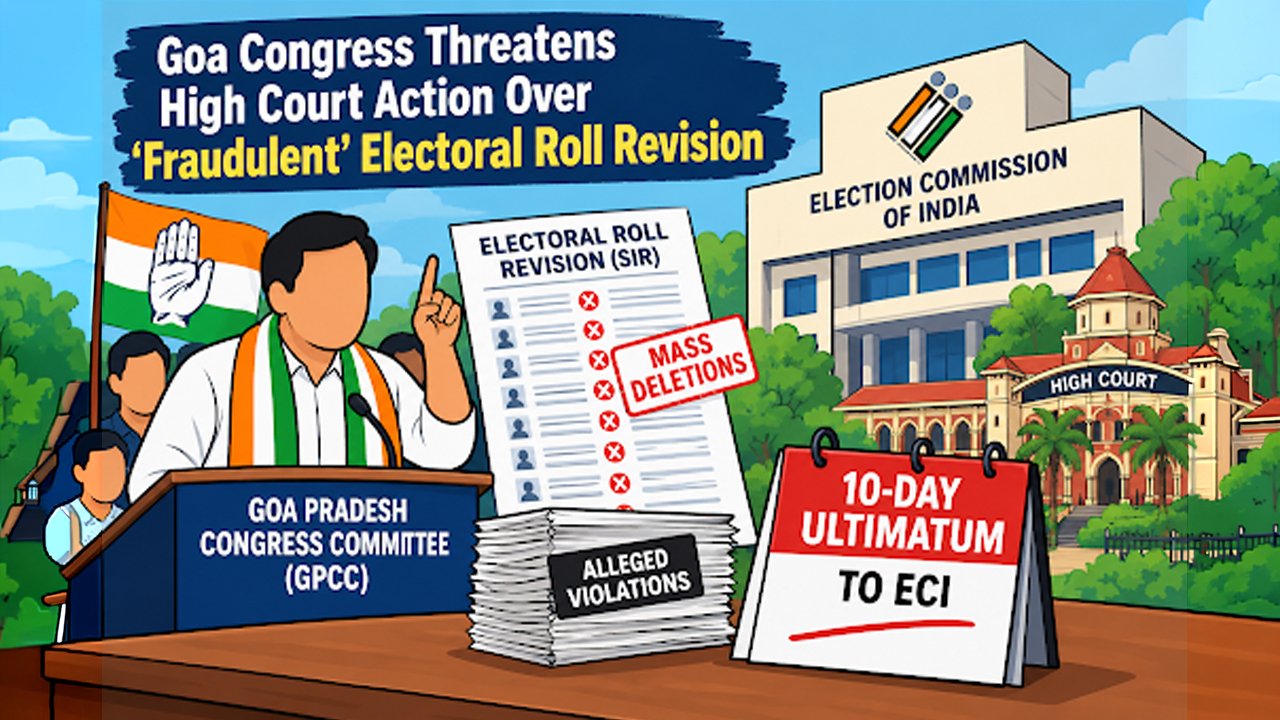
PANAJI: The Goa Pradesh Congress Committee (GPCC) has issued a 10-day ultimatum to the Election Commission of India (ECI), threatening High Court action over the ongoing Special Intensive Revision (SIR) of electoral rolls. But as Congress challenges the exercise in Goa, questions arise over the party’s position on electoral-roll revisions conducted during its own tenure and whether it applies the same standard across states where it has secured electoral victories.
Led by GPCC President Girish Chodankar, Congress staged a protest outside the Chief Electoral Officer’s office in Altinho, Panaji, alleging widespread violations in the revision process. The party claims that 1,39,634 voters, approximately 11.84% of Goa’s electorate, have been unlawfully removed and has demanded that the exercise be scrapped.
The protest has also put the spotlight on Congress’s broader position on SIR. If the party considers the exercise inherently undemocratic or legally questionable, how does it assess similar electoral-roll revision exercises undertaken under previous governments? And will it extend its objections to states where it has won elections, rather than limiting its challenge to the current political contest in Goa?
Congress Alleges Legal Violations in Goa
Chodankar has accused the ECI of violating Sections 21 and 22 of the Representation of the People Act, arguing that administrative guidelines cannot override statutory provisions. He further alleged that voters were denied mandatory notices and hearings before their names were deleted.
Congress has demanded an immediate halt to the revision and the restoration of the January 6, 2025 electoral roll. The party has warned that it will approach the High Court if its demands are not met within 10 days.
These remain allegations by the Congress, and the legal validity of the process will ultimately depend on the applicable law, official records and any judicial findings.
The Historical Question: What Was Congress’s Position on SIR?
The controversy raises a wider question about the history of intensive electoral-roll revision in India. Such exercises are not new to the country’s electoral system, and their use predates the current political dispute.
A closer examination of past revisions under Congress-led governments could establish how the process was implemented, what safeguards were provided to voters and whether political parties raised objections at the time. Any comparison, however, must distinguish between routine roll updates, intensive revisions and the present SIR exercise rather than treating them as identical.
The key question is whether Congress’s objections are based on the procedure itself, alleged violations in its implementation, or the political circumstances surrounding the current exercise.
Will Congress Apply the Same Standard in Kerala and Tamil Nadu?
Congress’s challenge in Goa also invites scrutiny of its position in states where it has won electoral victories or participated in governing coalitions. Will the party demand similar scrutiny of electoral-roll revision in Kerala and Tamil Nadu, where the political circumstances and governing arrangements differ?
The issue is not whether an electoral victory automatically validates a revision process—it does not. Nor does a party’s past use of an administrative process invalidate its present objections. The relevant questions are whether the law was followed, whether eligible voters were protected from wrongful deletion and whether the same principles are applied regardless of which party benefits politically.
For Congress, the challenge is to demonstrate that its opposition to SIR rests on consistent legal and democratic principles, rather than a position that changes with the electoral stakes.
As its 10-day ultimatum in Goa puts the Election Commission under pressure, the larger debate extends beyond one state: Is Congress opposing alleged procedural violations in SIR on principle, and is it prepared to apply that principle consistently across the country?
Read more: How Rahul Gandhi’s Goa Visit Accidentally Debunked Congress’s Dabolim Narrative