


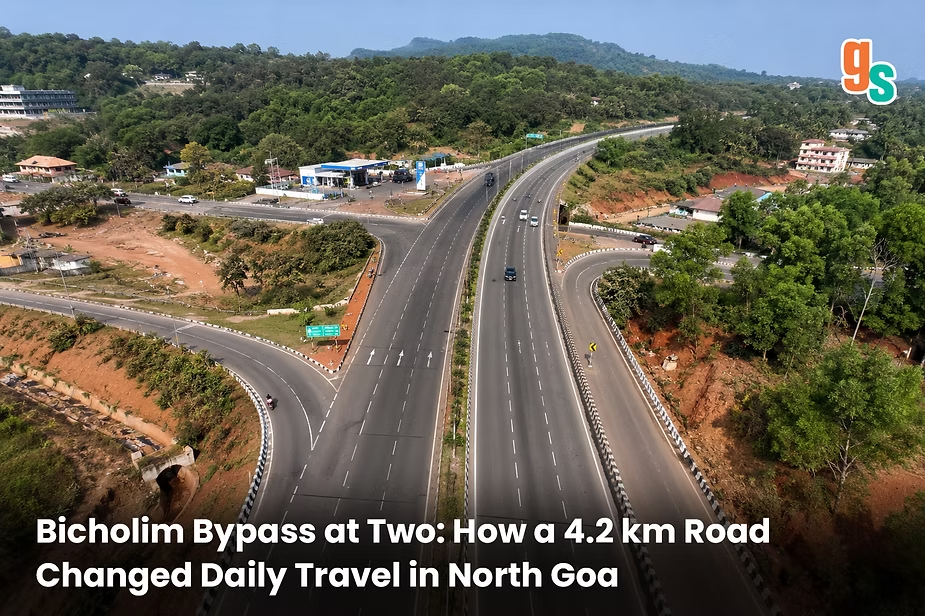
Built to ease one of North Goa’s worst traffic bottlenecks, the Bicholim Bypass continues to reshape commuting, freight movement, and regional connectivity. But safety concerns at its junctions show that infrastructure projects require constant refinement.
The traffic jams that defined Bicholim are no longer the daily story
For years, anyone travelling between Mapusa, Sanquelim, Valpoi, or the mining belt knew what awaited them inside Bicholim town. Long queues of trucks, buses squeezing through narrow stretches, and commuters losing precious time became part of everyday life.
That picture changed in June 2024 when Goa inaugurated the four-lane Bicholim Bypass, diverting through traffic away from the town centre. Two years later, the bypass has become a permanent part of North Goa’s transport network, offering a faster route for commuters while changing how traffic moves across the region.
Read Also: Goa’s AI Traffic Cameras Are Live. Here’s What Every Motorist Needs to Know Before Your Next Drive
Why the bypass was needed
Bicholim sits on one of North Goa’s most important road corridors. The route connects Bardez with the eastern parts of the state, including Sanquelim, Valpoi and industrial areas that support manufacturing and logistics.
As economic activity increased and freight movement grew, the existing road through Bicholim town reached its capacity. Heavy vehicles shared space with local traffic, school buses, pedestrians and commercial activity, creating congestion during peak hours.
The bypass was designed to separate long-distance traffic from local movement rather than simply widen the existing road through the town.
What the project delivered
Constructed as a four-lane road stretching just over four kilometres, the bypass was developed with state funding at a cost of about ₹84 crore under the Engineering, Procurement and Construction (EPC) model.
According to the state government, the project was intended to reduce peak-hour travel time, divert heavy vehicles from the town centre and improve connectivity between the Thivim and Bicholim industrial estates. It was also planned as part of a broader effort to strengthen transport infrastructure across Bicholim taluka.
A broader economic role
The bypass is more than a commuter road.
It forms part of State Highway 1, one of North Goa’s key transport corridors linking industrial clusters with ports, markets and other parts of the state.
Government announcements at the time of inauguration also positioned the road as an industrial corridor capable of supporting future economic activity. Parallel investments, including a new Bicholim bus stand and plans for improved public infrastructure, indicate that the bypass was conceived as part of a wider regional development strategy rather than an isolated road project.
The benefits residents experience
While comprehensive post-project traffic studies have not been publicly released, the intended benefits remain visible in how the road functions today.
For many motorists travelling between Mapusa and Sanquelim, the bypass removes the need to navigate busy town intersections. Heavy vehicles no longer need to pass through the commercial centre, reducing conflict between local and through traffic.
For businesses, smoother freight movement means greater reliability along an important industrial route.
For emergency services and public transport, reduced congestion can translate into more predictable travel times.
These are the kinds of incremental improvements that often receive less attention than ribbon-cutting ceremonies but shape daily life over the long term.
Infrastructure also brings new challenges
The bypass has not been without criticism.
Even before its inauguration, local residents called for additional traffic-calming measures at entry and exit points, expressing concern that higher vehicle speeds could increase accident risks.
Those concerns resurfaced in the Goa Legislative Assembly in 2026, where Bicholim MLA Chandrakant Shetye highlighted accidents at both ends of the bypass and urged improved engineering of junctions while discussing lessons for the under-construction Assonora Bypass.
These observations do not diminish the value of the project. Instead, they illustrate an important reality of transport infrastructure: opening a road is only the beginning. Monitoring safety performance, redesigning junctions where necessary and responding to user feedback are equally important parts of infrastructure management.
What comes next
The Bicholim Bypass also offers a template for future projects in North Goa.
Construction has already begun on the Assonora Bypass, another project intended to ease congestion along the same regional corridor and strengthen connectivity between Bardez and Bicholim. Lessons learned from the Bicholim project, particularly around junction safety and traffic management, are expected to inform its design and execution.
The bigger picture
Infrastructure is often judged by the day it opens. Its real value, however, becomes visible only after years of daily use.
Two years after its inauguration, the Bicholim Bypass has become an essential part of North Goa’s road network. It has helped move heavy traffic away from the town centre, improved regional connectivity and made everyday journeys more predictable for thousands of commuters.
At the same time, the discussion around road safety reminds us that successful infrastructure is not static. It must continue to evolve as traffic patterns change and communities identify new challenges.
The bypass has eased a long-standing bottleneck. The next measure of success will be how effectively authorities continue to improve it.