


From the hills of Sattari to the orchards of Canacona, Goa’s iconic crop continues to sustain livelihoods, preserve traditions and power an industry that defines every Goan summer. Yet the latest figures also raise important questions about the future of cashew cultivation.
At a Glance
- Goa produced 17.87 thousand tonnes of cashew during 2025-26.
- The figures come from the Union Agriculture Ministry’s Second Advance Estimates presented in Parliament.
- Cashew remains one of Goa’s most important horticulture crops and supports thousands of farming families.
- The Centre says it will continue supporting cultivation, processing and value addition through multiple schemes.
- However, independent reports indicate production has declined sharply compared to the previous year, highlighting concerns over productivity and ageing plantations.
The Crop That Quietly Defines Goa’s Identity
Goan knows another season that defines life here.
The arrival of cashew.
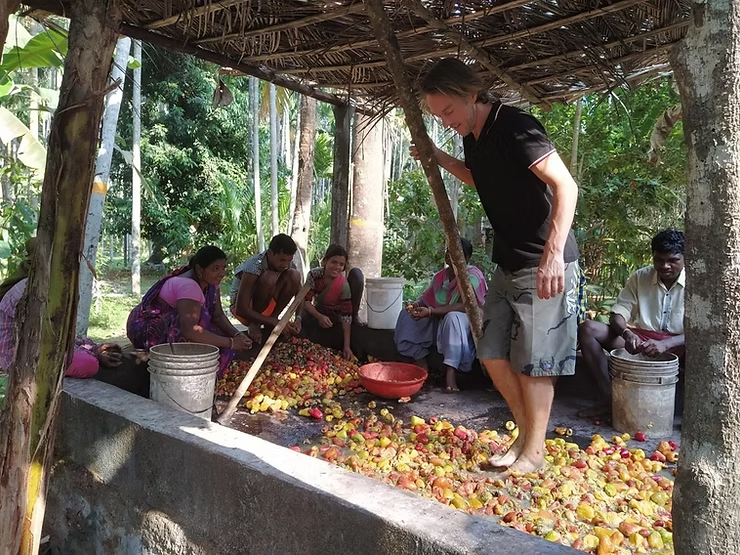
It begins with the bright yellow and red cashew apples hanging from trees across villages. Roadside stalls fill with fresh fruit. Families begin speaking about urrak season. Farmers prepare for harvest while local processing units come alive.
For many, it is nostalgia.
For thousands of others, it is a livelihood.
Now, the latest figures from the Union Ministry of Agriculture reveal that Goa produced nearly 17,900 tonnes of cashew during 2025-26.
It is a statistic that may seem ordinary at first glance.
It isn’t.
Because behind every kilogram of cashew lies a story of agriculture, tradition, employment and an industry that continues to shape rural Goa.
More Than Just a Harvest: What the New Numbers Reveal
The production figures were tabled in the Lok Sabha by Minister of State for Agriculture Ramnath Thakur in response to a parliamentary question.
According to the Ministry’s Second Advance Estimates:
- Goa: 17.87 thousand tonnes
- Maharashtra: 182.79 thousand tonnes
- Karnataka: 65.82 thousand tonnes
Together, the Konkan belt produced an estimated 266.48 thousand tonnes of cashew during 2025-26.
For Goa, however, the significance extends far beyond comparisons.
Cashew is one of the state’s signature horticulture crops. It feeds an entire value chain that includes cultivation, processing, retail, tourism and the internationally recognised feni industry.
[Read Also: https://www.goaspeaks.in/post/6-food-businesses-in-anjuna-ordered-to-suspend-operations-by-fda]
Why Every Goan Should Care
Every harvest season creates economic activity across rural Goa.
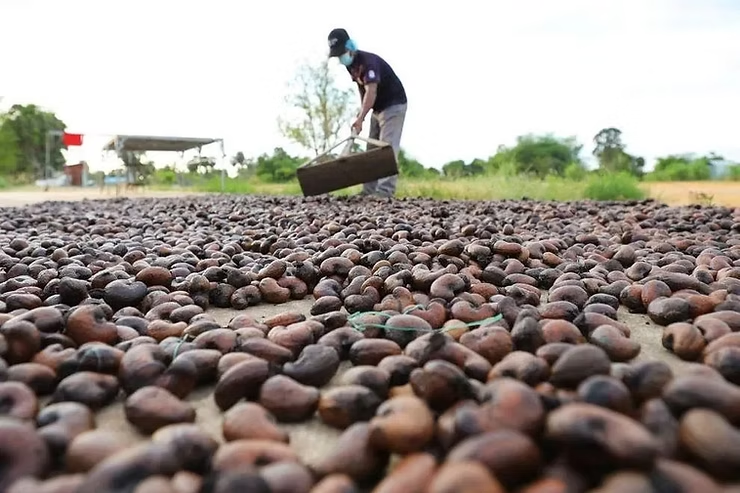
Farmers earn income from nuts and apples.
Small processing units employ local workers.
Transporters move produce.
Retailers sell processed kernels.
Distillers prepare the next batch of urrak and cashew feni.
Seasonal workers find employment during collection and processing.
For many villages, the cashew season remains one of the most economically important periods of the year.
That is why production data is far more than an agricultural statistic.
It is an indicator of rural economic health.
A Legacy That Began Centuries Ago Still Shapes Modern Goa
Cashew is not native to India.
Portuguese traders introduced the crop centuries ago, primarily to prevent soil erosion across Goa’s laterite hills.
Over time, it became one of the state’s defining agricultural identities.
Today, cashew is woven into Goan cuisine, festivals, tourism and exports.
From roasted kernels to sweets, from traditional drinks to small-scale entrepreneurship, the crop has evolved into an ecosystem rather than simply an agricultural product.
The Bigger Challenge Is Not Production. It’s productivity.
While the latest figures confirm Goa remains an important cashew-producing state, they also reveal an uncomfortable reality.
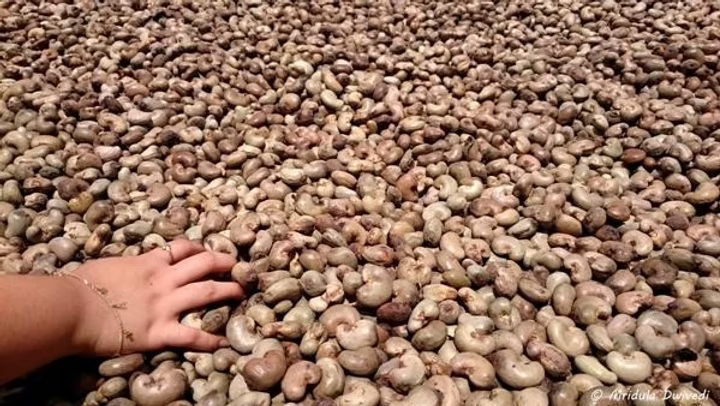
Independent reporting based on state data suggests production may have fallen by around 28 per cent compared to the previous agricultural year, dropping from roughly 24,882 tonnes to 17,870 tonnes.
Experts have repeatedly pointed to several structural challenges.
- Ageing plantations
- Low-yield varieties
- Pest attacks
- Labour shortages
- Fragmented land holdings
- Reduced interest among younger farmers
- Climate variability
Unless productivity improves, maintaining long-term output could become increasingly difficult.
What Governments Say They Are Doing
The Union Government says several schemes are available to strengthen the sector.
These include:
- Mission for Integrated Development of Horticulture (MIDH)
- Rashtriya Krishi Vikas Yojana (RKVY)
- Agriculture Infrastructure Fund (AIF)
Under MIDH, financial assistance is available for establishing or upgrading primary processing units for drying, grading and minimal processing, with support covering up to 35% of eligible capital costs, subject to prescribed limits.
The Agriculture Infrastructure Fund also provides 3% interest subvention along with credit guarantee support for eligible processing infrastructure.
These initiatives are aimed at improving productivity, expanding value addition and encouraging investment across the cashew value chain.
Has the Opposition Responded?
As of publication, no major opposition party has issued a specific response to the latest production estimates released in Parliament.
However, concerns over declining yields, farmer incomes and long-term sustainability of Goa’s cashew sector have featured in public discussions and industry forums over recent years.
Experts Say Goa Must Focus on Quality, Not Just Quantity
Agriculture specialists have long argued that Goa’s competitive advantage does not lie in producing the largest volumes.
Instead, the opportunity lies in premium branding.
Higher-quality kernels.
GI-linked products.
Better processing.
Modern plantation management.
Improved disease control.
Value-added products.
With limited cultivable land compared to larger states, increasing productivity per hectare and improving farmer earnings may prove more valuable than chasing higher production volumes.
The immediate focus is likely to remain on improving productivity rather than expanding cultivation.
Future investments are expected to centre around:
- Plantation rejuvenation
- Better processing infrastructure
- Improved planting material
- Technology adoption
- Greater value addition
- Stronger farmer support
If these efforts succeed, Goa’s cashew industry could become more profitable even without dramatically increasing cultivated area.