


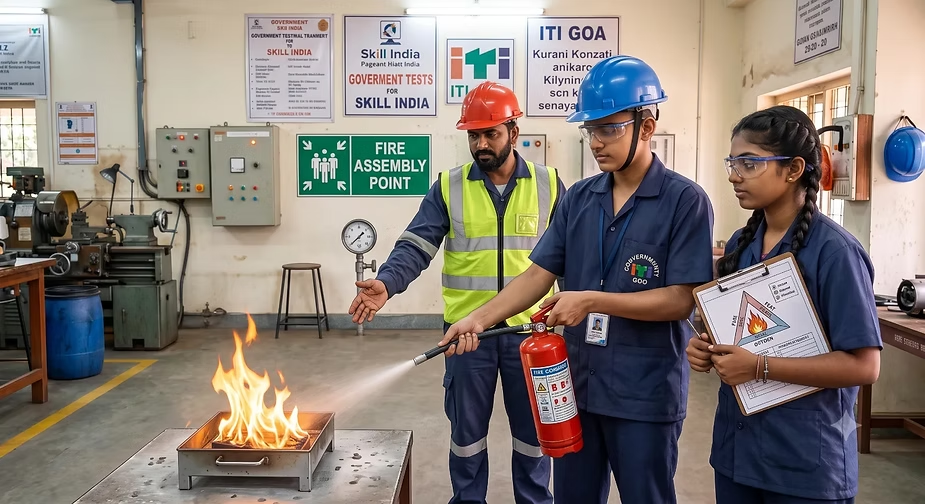
Two government ITIs have partnered with Goa Fire & Emergency Services to launch industry-integrated training in Fire Technology and Industrial Safety. Beyond a new course, this could reshape how Goa prepares its emergency workforce and creates skilled career opportunities for young Goans.
At A Glance
- Two Government ITIs at Mapusa and Cacora have launched industry-integrated Fire Technology and Industrial Safety training.
- Students will combine classroom learning with practical training alongside Goa Fire & Emergency Services personnel.
- Government ITI Mapusa will follow the Dual System of Training (DST) while Government ITI Cacora will use an On-the-Job Training (OJT) model.
- The Chief Minister has indicated that a recognised ITI qualification in Fire Technology and Industrial Safety Management may become a prerequisite for future recruitment into the Fire & Emergency Services Department. This is an indication, not yet a notified policy.
The Next Generation of Firefighters May Not Start at a Fire Station
There are few professions where every second matters.
When a factory catches fire, a chemical leak spreads, or a family is trapped inside a burning building, the quality of the response depends on one thing: training.
For decades, India’s emergency response ecosystem has largely focused on training personnel after recruitment. Goa is now experimenting with a different idea.
Train them first.
Recruit them later.
It may sound like a small administrative decision involving two government ITIs, but its implications stretch far beyond vocational education. If implemented successfully, it could create a dedicated pipeline of industry-ready fire safety professionals while strengthening Goa’s emergency preparedness and industrial safety ecosystem.
Sometimes, the biggest reforms are not announced with fanfare. They quietly begin inside classrooms.
A Classroom Is Now Becoming Goa’s First Line of Defence
The Directorate of Fire & Emergency Services has signed Memoranda of Understanding with Government ITI Mapusa and Government ITI Cacora to introduce industry-integrated training in Fire Technology and Industrial Safety Management.
The programmes are structured differently.
Government ITI Mapusa will operate under the Dual System of Training, where classroom instruction is integrated with structured industry exposure.
Government ITI Cacora will adopt an On-the-Job Training approach, allowing trainees to work alongside experienced fire service personnel during their learning process.
Instead of limiting education to textbooks, students will participate in practical rescue drills, emergency response operations and industrial safety procedures.
This brings vocational education much closer to real-world working conditions.
Why This Matters Far Beyond One ITI Course
Goa is changing something fundamental.
Rather than expecting recruits to learn everything after joining the department, the state is attempting to create a pool of candidates who already possess specialised knowledge before recruitment.
That has several advantages.
Industries increasingly require trained fire and safety personnel because of stricter workplace safety norms.
Hospitals, hotels, manufacturing facilities, logistics parks and large commercial complexes all require professionals trained in emergency preparedness.
The same skill set is also relevant for disaster management, occupational health and industrial compliance.
If the model succeeds, Goa could produce graduates who are employable across both government and private sectors instead of depending on a single recruitment channel.
Goa Has Been Building This Skill Ecosystem for Years
The latest initiative did not emerge overnight.
Goa’s Directorate of Skill Development and Entrepreneurship has spent several years expanding industry-linked vocational education.
The state currently has 10 Government ITIs and 3 Private ITIs, offering 44 engineering and non-engineering trades under national vocational training frameworks.
The Dual System of Training itself was introduced to bridge the long-standing gap between classroom education and industry requirements.
Under the model, theoretical instruction is delivered through ITIs while practical training is conducted in industry or partner establishments, improving employability and ensuring graduates are workplace ready.
Goa has also previously collaborated with Siemens and GIZ to introduce German-style Dual Vocational Education and Training across its Government ITIs, reflecting a broader strategy to modernise technical education.
The fire safety partnership fits naturally into this larger transformation.
What This Means for Young Goans
For many students, vocational education has traditionally been viewed as a second choice.
That perception has slowly begun to change.
Industry-integrated programmes reduce one of the biggest problems faced by fresh graduates.
Lack of experience.
Students completing this programme will leave with exposure to real emergency operations rather than purely theoretical knowledge.
The Fire Technology and Industrial Safety Management trade also carries specific physical eligibility standards, including minimum height, weight and chest measurements, reflecting the demanding nature of emergency service work.
For young people considering careers in public safety, industrial safety or emergency response, the pathway has become much clearer.
The Numbers Behind Goa’s Skill Push
- 2 Government ITIs participating in the new fire safety partnership.
- 10 Government ITIs currently operate in Goa.
- 3 Private ITIs function alongside them.
- 44 Engineering and non-engineering trades are offered across Goa’s ITI network.
- The Fire Technology and Industrial Safety Management trade has defined physical fitness standards for admission.
This Could Be the Beginning of a Bigger Shift
If the programme delivers well-trained graduates and improves employment outcomes, Goa may establish a model that other states seek to replicate.
The real story is not simply that two ITIs have launched a new course.
It is that Goa is attempting to solve two challenges at once.
Preparing skilled emergency responders.
And giving young people a clearer pathway into meaningful careers.
Sometimes the strongest emergency response begins long before the sirens start.