


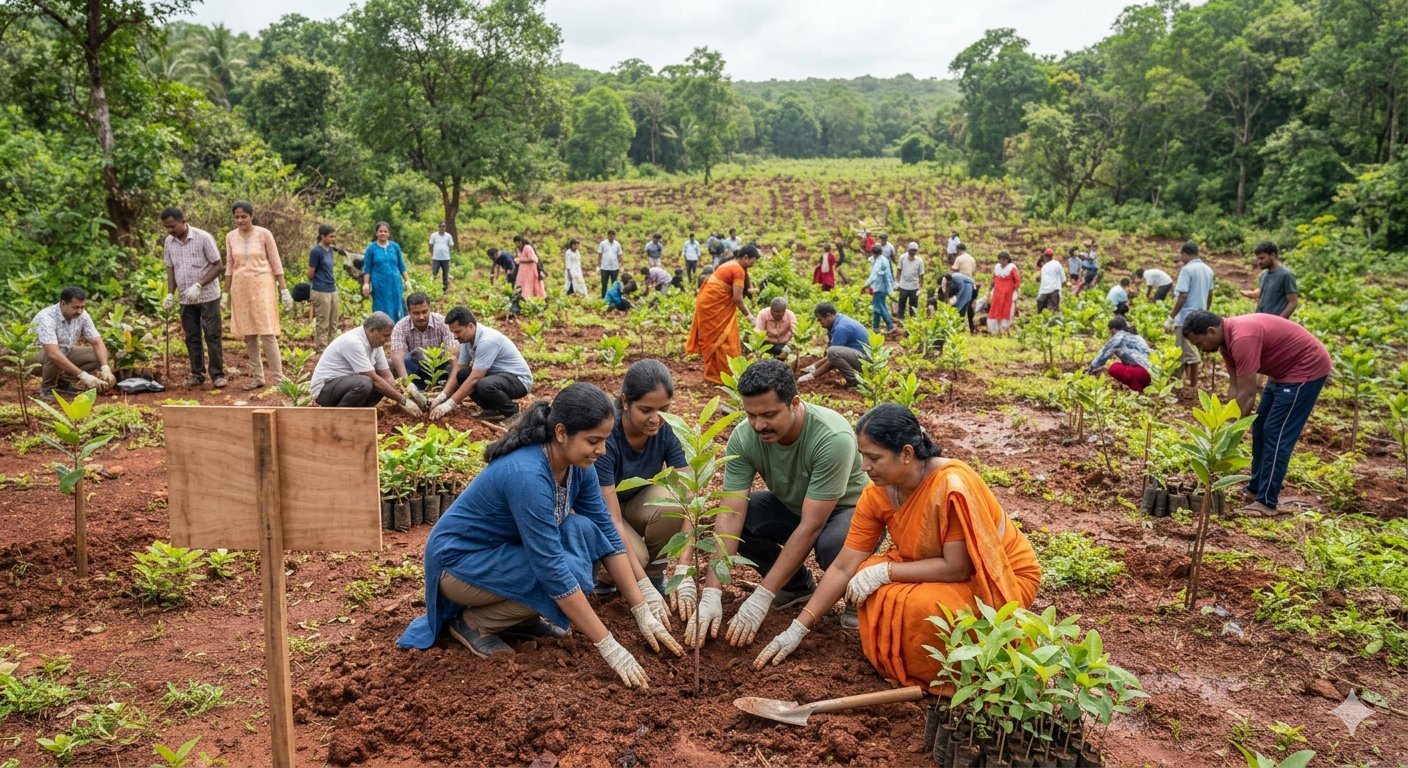
The Goa Forest Department is launching a major ecological push. Officials have finalized a three-year master plan to clear the state’s 246.58-hectare backlog of compensatory afforestation (CA). The National Compensatory Afforestation Fund Management and Planning Authority (National CAMPA) recently approved this targeted roadmap. The initiative aims to wipe out long-standing ecological deficits by the end of the 2028-29 financial year.
The Goa Forest Department is launching a major ecological push. Officials have finalized a three-year master plan to clear the state’s 246.58-hectare backlog of compensatory afforestation (CA).
For years, infrastructure expansion and land diversion left a gap between lost woodland and replanted trees. This new phased strategy directly addresses that imbalance to restore Goa’s vital forest cover.
The Phased Replanting Roadmap
The state will not plant all the trees at once. To ensure high survival rates and proper soil management, the Forest Department is splitting the 246.58-hectare restoration project into three distinct phases:
- Phase 1 (2026-27): Teams will plant the first 80 hectares of degraded land.
- Phase 2 (2027-28): Workers will cover the next 80 hectares with native saplings.
- Phase 3 (2028-29): The department will clear the final 86.57 hectares to complete the backlog.
This systematic timeline allows foresters to monitor early growth closely before scaling up operations.
Robust Funding Powers the Green Initiative
Securing financial backing is critical for large-scale tree planting, and Goa has the resources ready.
The Goa government has earmarked ₹11.84 crore for compensatory afforestation in the current financial year alone. Additionally, the state allocated ₹2.04 crore for site-specific environmental protection operations.
While National CAMPA recently reduced Goa’s overall annual budget allocation by 27%, the state still holds a massive ₹345.09 crore across various CAMPA fund categories. This substantial reserve ensures that funding shortages will not stall the three-year master plan.
Read Also: Goa plans healthcare at home for elderly
Overcoming the Land Bank Bottleneck
Why did the backlog accumulate in the first place? Historically, officials struggled to identify and secure suitable land for mandatory replanting.
To break this bottleneck, the state established a dedicated Project Management Unit (PMU) under directives from the Union Ministry of Environment, Forest and Climate Change (MoEFCC).
The PMU is actively building a centralized land bank of degraded forest areas. When developmental projects require land diversion, developers can instantly access this land bank. This system accelerates the allocation process and gets planting crews on the ground faster.
Goa’s Broader Conservation Track Record
Despite the current backlog, Goa maintains a strong overall record for environmental mitigation. Out of a cumulative mandated target of 3,566.38 hectares of compensatory afforestation, the state has already successfully restored 3,319.81 hectares.
This new three-year master plan bridges the remaining gap, putting Goa on track to achieve 100% of its historic conservation commitments.