


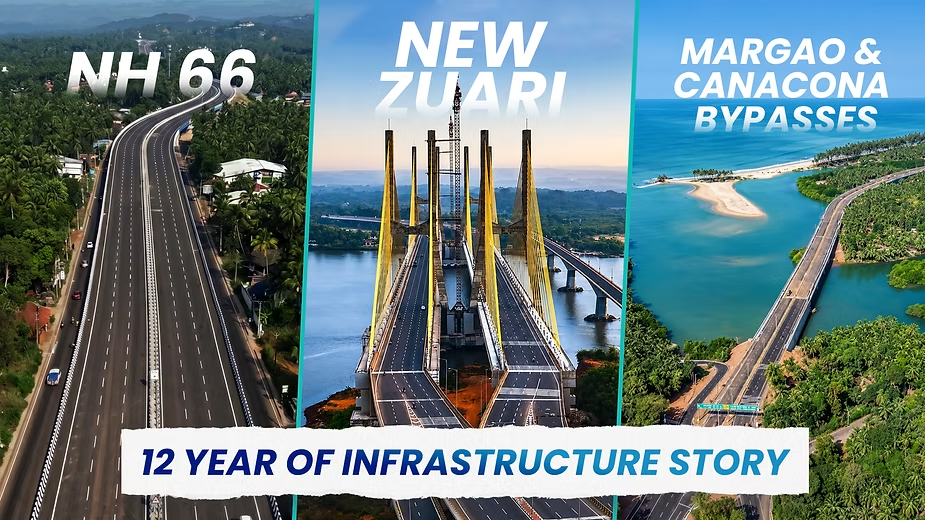
From iconic bridges and airport highways to bypasses that have eased some of Goa’s busiest traffic bottlenecks, the state’s road network has undergone one of its biggest transformations in decades. The Goa Pavilion at the 237th IRC Mid-Term Council Meeting is putting that journey in the national spotlight.
At a Glance
- Goa showcased its infrastructure journey at the 237th IRC Mid-Term Council Meeting.
- The state has a 280.5 km National Highway network.
- 126.5 km of National Highways have been upgraded to four lanes since 2014.
- Another 60 km of highway projects are under construction or tendered.
- Landmark projects include the New Zuari Bridge, NH-66 four-laning, Canacona Bypass, Margao Western Bypass, Mopa Airport Link Road, Khandepar Bridge, and the Mormugao Port Connectivity Project.
- The New Zuari Bridge and Mormugao Port Connectivity Project have received national infrastructure recognition.
Goa’s Biggest Infrastructure Story Was Never Just About Roads
Every Goan has experienced it.
The drive that once took nearly an hour now takes considerably less. The endless queues before crossing the Zuari have become memories for many commuters. Travelling from North Goa to South Goa no longer means preparing for multiple choke points before reaching your destination.
These changes did not happen overnight.
Over the past decade, Goa has quietly undergone one of the largest transformations of its road infrastructure since Liberation. While political debates often dominate headlines, concrete, steel and asphalt have been steadily reshaping how people travel, how businesses transport goods and how tourists experience the state.
This week, that transformation found a national stage.
At the 237th Mid-Term Council Meeting of the Indian Roads Congress (IRC), Goa unveiled its Infrastructure Pavilion, presenting before engineers, planners and policymakers the projects that have fundamentally altered the state’s transport landscape. The exhibition is less about celebrating completed projects and more about demonstrating how a geographically small state tackled some of its biggest mobility challenges through targeted investments in highways, bridges and strategic bypasses.
For most Goans, however, the real story is not inside the exhibition hall.
It is on the roads they drive every single day.
What the Goa Pavilion Is Really Showcasing
At first glance, the Goa Pavilion appears to be another government exhibition.
Look closer and it tells a much bigger story.
The pavilion documents the evolution of Goa’s National Highway network over the last twelve years. According to the Public Works Department, Goa currently has six National Highways stretching across 280.5 kilometres. Since 2014, 126.5 kilometres have been widened to four lanes, while another 60 kilometres are either under construction or have already been tendered for execution.
Behind these numbers are projects that have become familiar landmarks across the state:
- New Zuari Bridge and its approaches
- Four-laning of NH-66 between Patradevi and Bambolim
- Six-lane connectivity road to Manohar International Airport at Mopa
- Margao Western Bypass
- Canacona Bypass
- New Khandepar Bridge
- Mormugao Port Connectivity Project
- Bicholim Bypass completed by the Goa PWD using state funds
Each project addressed a different transport challenge. Some removed urban congestion. Others created faster freight corridors. Several improved safety by eliminating dangerous bottlenecks and river crossings. Collectively, they represent a strategic shift from simply building roads to redesigning mobility across Goa.
The state also highlighted that both the New Zuari Bridge and the Mormugao Port Connectivity Project have received national recognition at the ICI-UltraTech Infrastructure Awards, underscoring their engineering significance.
Why This Matters Far Beyond Traffic
Infrastructure is often measured in kilometres.
Its real impact is measured in opportunities.
Every additional minute saved on a highway translates into lower transport costs, quicker emergency response, improved logistics for industries, more predictable commuting and stronger regional integration.
Goa’s economy depends heavily on movement.
Tourism requires seamless airport connectivity.
Mining and port operations rely on efficient freight corridors.
Businesses need reliable logistics.
Residents need safer and faster access to workplaces, hospitals and educational institutions.
Projects like the New Zuari Bridge have done more than replace ageing infrastructure. They have created additional traffic capacity across one of Goa’s most important transport corridors, improving resilience during peak tourist seasons and reducing dependence on older crossings.
Similarly, the six-lane approach road connecting NH-66 with Manohar International Airport has strengthened connectivity to North Goa’s newest aviation hub, ensuring that airport expansion is supported by modern road infrastructure rather than outdated local roads.
The bypasses at Margao and Canacona are equally significant. By diverting through traffic away from dense urban centres, they reduce congestion inside towns while improving travel efficiency for long-distance vehicles.
Taken together, these projects are gradually changing the economics of movement across Goa.
That is perhaps the most important story the Pavilion is trying to tell.
A Decade of Building the Missing Links
Goa’s geography has always been both its strength and its challenge.
The state is intersected by rivers, narrow settlements, forested stretches and densely populated urban corridors. For decades, these natural and urban constraints created transport bottlenecks that affected both daily commuters and commercial traffic.
Rapid economic growth during the 2000s further exposed the limitations of the existing network. Rising vehicle ownership, increasing tourism and expanding industrial activity placed enormous pressure on roads that were originally designed for much smaller traffic volumes.
The response over the past decade has been markedly different from piecemeal upgrades.
Instead, planners have focused on creating an integrated network where highways, bridges, bypasses and port connectivity projects complement one another.
The four-laning of NH-66 has improved one of Goa’s most critical north-south corridors. The Mormugao Port Connectivity Project has strengthened freight movement to one of India’s key ports. The Khandepar Bridge has modernised an ageing river crossing. The Bicholim Bypass has eased traffic in one of North Goa’s busiest inland towns.
Perhaps the most symbolic project remains the New Zuari Bridge.
Beyond serving as an engineering landmark, it represents Goa’s broader transition from infrastructure that merely coped with demand to infrastructure designed for future growth.
And the story is still unfolding.
The state has announced that work on observatory towers and viewing galleries on the New Zuari Bridge is expected to commence shortly, adding a tourism dimension to one of Goa’s most recognisable engineering structures and potentially creating a new attraction overlooking the Zuari estuary.
The Real Winners Are the People Who Use These Roads Every Day
For years, conversations about infrastructure in Goa often revolved around delays, diversions and construction work. Today, many of those conversations have shifted to something much more tangible: shorter journeys, safer roads and better connectivity.
For a daily commuter travelling between North and South Goa, the impact is measured in predictability. Peak-hour traffic has not disappeared, but several chronic bottlenecks have been eased by wider highways, new bridges and bypasses that divert through traffic away from town centres.
Businesses have also benefited. Faster freight movement means lower transportation costs and more reliable delivery schedules. This is particularly significant for industries linked to the Mormugao Port, one of the state’s most important economic gateways. Improved connectivity to the port reduces delays for cargo movement and strengthens Goa’s competitiveness as a logistics destination.
Tourism, the backbone of Goa’s economy, has perhaps witnessed one of the most visible transformations. The six-lane connectivity road to Manohar International Airport at Mopa has dramatically improved access to North Goa, while upgraded highways have made road travel between beaches, heritage sites and commercial centres more convenient.
Emergency services also stand to benefit. Wider carriageways and bypasses improve access for ambulances, fire services and disaster response teams, especially during the monsoon when road conditions become more challenging.
Infrastructure, in this context, is not merely an engineering achievement. It is a quality-of-life investment that affects millions of individual journeys every year.
The Government’s Case: Building for the Next Generation
The Goa Government has consistently argued that these projects are not isolated developments but part of a long-term strategy to modernise the state’s transport infrastructure.
According to the Public Works Department’s presentation at the Goa Pavilion, the completed projects have delivered several measurable outcomes:
- Reduced traffic congestion across major corridors.
- Improved road safety through wider carriageways and modern bridge infrastructure.
- Enhanced connectivity between North and South Goa.
- Better access to industrial, tourism and port infrastructure.
- Stronger foundations for future economic growth.
The presentation also highlights that work is expected to begin shortly on observatory towers and viewing galleries on the New Zuari Bridge. While primarily a transport asset, the bridge is now being envisioned as a tourism landmark that could attract visitors while generating additional economic activity around the Zuari estuary.
The government’s broader message is clear: infrastructure should not simply meet today’s demand. It should anticipate tomorrow’s growth.
Civil engineers often describe transport infrastructure as an economic multiplier.
Every new bridge, bypass or highway influences far more than vehicle movement. It affects investment decisions, property development, tourism patterns, industrial growth and regional competitiveness.
The New Zuari Bridge is a case in point. Besides reducing congestion on one of Goa’s busiest river crossings, it has become an engineering landmark that symbolises the state’s modern infrastructure ambitions. Its cable-stayed design is not merely architectural; it represents the adoption of advanced engineering solutions capable of supporting future traffic volumes.
Similarly, the Mormugao Port Connectivity Project demonstrates how transport investments can improve supply chains. By strengthening road connectivity to the port, the project supports trade efficiency and reduces travel delays for commercial vehicles.
Experts also note that bypasses deliver benefits extending well beyond travel time. They improve air quality in congested town centres, reduce heavy vehicle movement through residential areas and enhance road safety by separating local traffic from long-distance transit.
Viewed collectively, these projects represent the gradual creation of an integrated transport network rather than isolated construction works.
The Numbers That Tell the Story
Behind every completed bridge and highway lies a broader picture of transformation.
National Highway Network
- 6 National Highways
- 280.5 kilometres of National Highways across Goa
Four-Laning Progress
- 126.5 kilometres completed since 2014
- 60 kilometres under construction or tendered
Major Completed Projects
- New Zuari Bridge and approaches
- NH-66 four-laning from Patradevi to Bambolim
- Six-lane Manohar International Airport Link Road
- Canacona Bypass
- Margao Western Bypass
- New Khandepar Bridge
- Mormugao Port Connectivity Project
- Bicholim Bypass
National Recognition
The New Zuari Bridge and the Mormugao Port Connectivity Project have received recognition at the ICI-UltraTech Infrastructure Awards, highlighting their engineering and construction excellence.
Individually, these figures may appear technical. Together, they illustrate a decade-long effort to reshape how people, goods and services move across Goa.
The Next Challenge Is Not Building More Roads. It’s Building Smarter Ones.
Goa’s infrastructure story is impressive, but it is far from complete.
Several major highway stretches are still under construction or in the tendering stage. As these projects are completed, attention will increasingly shift from expanding road capacity to managing mobility more efficiently.
Questions remain over how Goa will integrate its growing highway network with public transport, electric mobility, cycling infrastructure and smart traffic management systems. With vehicle registrations continuing to rise every year, infrastructure alone cannot solve congestion unless accompanied by better urban planning and transport policy.
The proposed observatory towers and viewing galleries on the New Zuari Bridge are another example of how infrastructure is evolving beyond its traditional role. If executed successfully, the bridge could become not just a transport corridor but also a tourism landmark, creating new opportunities for local businesses and visitors alike.
The next decade will test whether Goa can maintain the momentum while balancing environmental sustainability, economic growth and quality of life.
What Happens Next?
The Goa Pavilion is more than an exhibition. It is a statement of intent.
By presenting its infrastructure achievements before the country’s leading highway engineers and planners at the 237th IRC Mid-Term Council Meeting, Goa has positioned itself as a state willing to invest in long-term mobility rather than short-term fixes.
Several projects are expected to move forward in the coming months:
- Completion of the remaining 60 km of National Highway upgrades currently under construction or tendered.
- Commencement of the New Zuari Bridge observatory towers and viewing galleries.
- Continued strengthening of road connectivity to support tourism, logistics and industrial growth.
- Further improvements in road safety through modern engineering standards and upgraded highway infrastructure.
For citizens, the benefits will become visible not through announcements, but through everyday experiences: fewer bottlenecks, smoother journeys and stronger connectivity between the state’s towns, ports and airports.
Goa’s Infrastructure Story Is Part of a Much Bigger Transformation
The road network is only one piece of Goa’s larger development puzzle.
In recent years, the state has also witnessed major investments in aviation with the opening of Manohar International Airport, improvements in digital governance, expansion of tourism infrastructure, modernisation of port connectivity and initiatives aimed at strengthening logistics and economic competitiveness.
Together, these developments point towards a broader shift in how Goa is preparing for future growth. Infrastructure is increasingly being viewed as an economic enabler rather than simply a public works function.
The Goa Pavilion captures that transition.
It tells a story of bridges, bypasses and highways, but beneath the engineering drawings lies something much more important.
It is the story of a state trying to move faster, connect better and build for the next generation.
Whether viewed from the deck of the New Zuari Bridge, the highway to Mopa Airport or the bypasses that now carry thousands of vehicles every day, the transformation is already part of everyday life.
For many Goans, the biggest infrastructure revolution was never hidden behind construction barricades.
It was quietly unfolding beneath their wheels.