


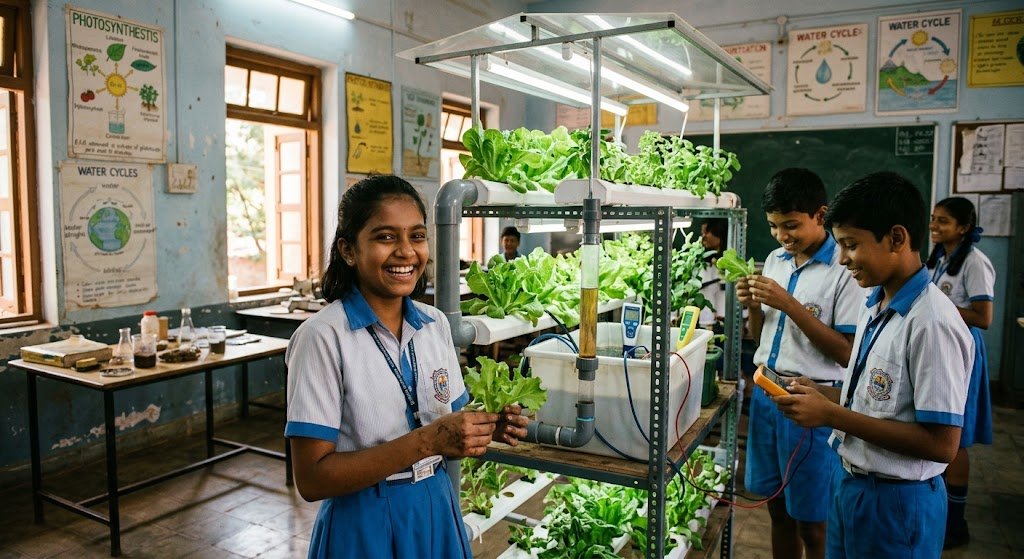
GOA: Around 30 schools across Goa have introduced students to hydroponics and kitchen gardening through practical demonstrations, bringing lessons about farming and food production out of textbooks and into the school environment.
The initiative is being conducted by fourth-year students of the Goa College of Agriculture under the Rural Agricultural Work Experience (RAWE) Programme, in collaboration with the World Wide Fund for Nature (WWF).
For the students taking part, agriculture is no longer just something they read about in a lesson. They get to see how plants are grown, understand how different systems work and, in the case of kitchen gardening, experience the process of growing food themselves.
From Lessons To Living Gardens
The demonstrations introduced students to hydroponics, soil-less cultivation, water and nutrient management, crop selection and kitchen gardening.
The idea is particularly relevant in a school setting, where growing food does not necessarily require large stretches of farmland. Small gardens and simple growing spaces can give children an opportunity to understand the basics of cultivation while making the connection between what they eat and how it is produced.
The initiative also gives practical context to concepts already included in the school curriculum. Kitchen gardening is part of the Class VI curriculum, while hydroponics is covered in Class VIII, allowing students to see some of those lessons in action.
And for many children, there is something quite different about learning by actually getting their hands into the soil or seeing a hydroponic system work in front of them.
Read Also: https://goaspeaks.in/konkani-opens-new-doors-central-govt-jobs-in-goa-to-prioritise-local-language-skills/
Making Agriculture More Familiar
The programme is also introducing students to a side of agriculture that goes beyond conventional farming.
Hydroponics brings together science, technology and cultivation, while kitchen gardening offers a simpler, more familiar way for children to engage with growing food.
Students interacted with the agriculture college students during the demonstrations, asked questions about hydroponic systems and showed interest in setting up kitchen gardens at their own homes and schools. Teachers, too, welcomed the opportunity to turn curriculum-based lessons into something students could experience first-hand.
For the fourth-year agriculture students conducting the demonstrations, the programme offers another kind of learning, taking their knowledge beyond college and communicating it directly to younger students and communities.
Dr Suresh Kunkalikar, Principal of the Goa College of Agriculture and Chairman of the RAWE Programme, highlighted the importance of taking agricultural knowledge beyond the college campus.
WWF Goa State Coordinator Aditya Kakodkar also pointed to the value of connecting school curriculum with practical demonstrations, particularly when it comes to understanding sustainable food production and the responsible use of natural resources.
Read Also: https://goaspeaks.in/goa-wrd-pushes-200-rainwater-harvesting-projects-to-strengthen-groundwater-security/
A Different Way Of Looking At Farming
What makes the initiative interesting is the way it introduces children to agriculture at an early age — not simply as traditional farming, but as something that can exist in a backyard, a school garden or even a small growing space.
That matters in a State like Goa, where conversations around sustainability, food and the environment are increasingly becoming part of everyday life.
For the students, the takeaway may be as simple as learning how a plant grows. But it can also mean discovering that growing food is not necessarily something that happens only on a farm, it can begin right outside the classroom.