


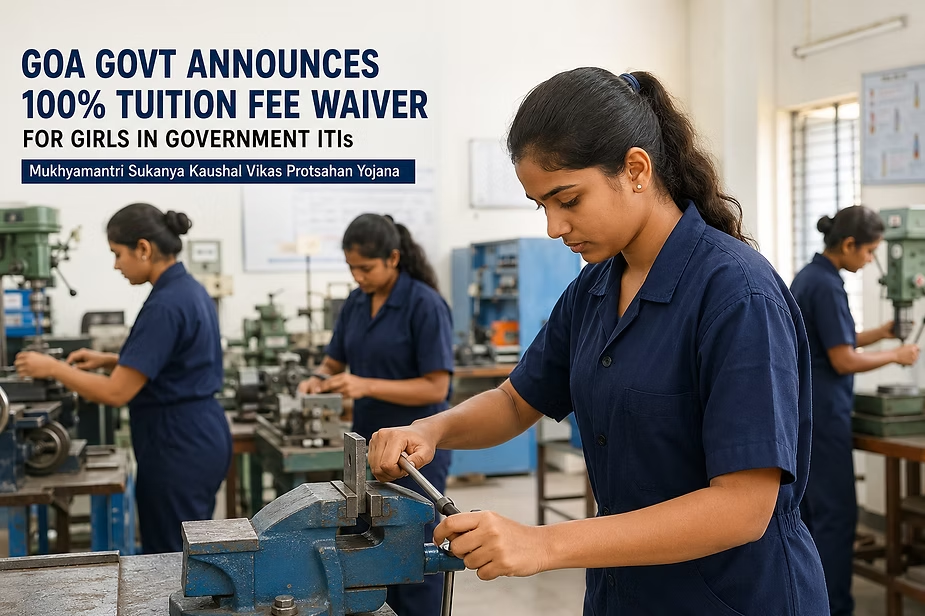
With a 100% tuition fee waiver for girls enrolling in Government Industrial Training Institutes, the Goa Government is seeking to expand women’s participation in technical education, bridge the gender gap in vocational training and strengthen the state’s future workforce.
At a Glance
- Goa has announced the Mukhyamantri Sukanya Kaushal Vikas Protsahan Yojana.
- Girls enrolling in Government ITIs will receive a 100% tuition fee waiver.
- The initiative aims to encourage greater participation of women in vocational and technical education.
- Goa currently has Government ITIs across the state, with admissions for the 2026-27 academic year already underway through the Directorate of Skill Development & Entrepreneurship.
- The announcement comes as India pushes for a larger skilled workforce to support manufacturing, infrastructure, tourism and emerging industries.
When Skill Becomes Affordable, More Dreams Become Possible
For decades, vocational education has quietly powered Goa’s economy.
The electrician who keeps hotels running. The refrigeration technician servicing restaurants during the tourist season. The machinist employed in Goa’s pharmaceutical sector. The computer operator managing offices across the state. Behind every thriving industry is a skilled workforce, much of it trained through Industrial Training Institutes.
Yet despite growing opportunities, women continue to make up only a small share of students pursuing technical trades across India. Financial constraints, social perceptions and limited awareness have often discouraged young women from considering vocational education as a first choice.
The Goa Government’s latest initiative seeks to change that equation.
Under the Mukhyamantri Sukanya Kaushal Vikas Protsahan Yojana, girls enrolling in Government ITIs will no longer pay tuition fees. The Cabinet has approved a 100% tuition fee waiver, removing one of the immediate financial barriers to technical education.
While the policy may appear straightforward, its implications stretch beyond education. It represents an investment in workforce participation, economic inclusion and the long-term competitiveness of Goa’s economy.
Removing the Cost of Learning a Skill
The announcement was made by Chief Minister Pramod Sawant following a meeting of the State Cabinet.
The scheme provides a complete tuition fee waiver for girls taking admission in Government Industrial Training Institutes across Goa. It is expected to come into effect for admissions beginning with the current academic cycle.
Industrial Training Institutes offer practical, employment-oriented courses in a range of trades including:
- Electrician
- Electronics Mechanic
- Computer Operator and Programming Assistant
- Fitter
- Welder
- Refrigeration and Air Conditioning Technician
- Draughtsman
- Fashion Design and Technology
- Secretarial Practice
- Information Technology
Unlike conventional academic degrees, ITIs focus on hands-on training designed to prepare students directly for employment or entrepreneurship.
Admissions for the 2026-27 academic year are already open through the Directorate of Skill Development and Entrepreneurship, which oversees Government ITIs across Goa.
For many families, even relatively modest tuition fees can influence educational choices. By eliminating that cost entirely, the government hopes to encourage more girls to opt for vocational education.
The timing is also significant.
Across India, governments are placing greater emphasis on skill development as industries increasingly seek technically trained workers rather than only degree holders.
Goa’s decision aligns with this broader national direction while addressing a local challenge: improving female participation in technical education.
Why This Matters Beyond the Classroom
The importance of this policy cannot be measured simply by the amount of tuition waived.
Its real significance lies in who enters the classroom as a result.
Across India, women remain underrepresented in many technical trades despite increasing demand from sectors such as manufacturing, renewable energy, hospitality, logistics, construction and electronics.
According to NITI Aayog’s national assessment of Industrial Training Institutes, Goa has more than 4,000 approved ITI seats across Government and private institutions. However, female enrolment remains relatively low, at around 16.6% during the period studied.
That gap matters because vocational education increasingly serves as a direct pathway into employment.
Unlike many traditional academic programmes, ITIs typically emphasise industry partnerships, apprenticeships and practical workplace skills. Graduates often enter the labour market immediately after completing their training.
For Goa, whose economy depends on tourism, hospitality, pharmaceuticals, shipbuilding, logistics, manufacturing and infrastructure development, expanding the pool of skilled workers is an economic necessity.
Increasing women’s participation also broadens the available workforce at a time when industries across the country report shortages of skilled technicians.
The policy therefore carries both a social objective and an economic one.
It seeks to make technical education more inclusive while simultaneously strengthening the state’s human capital.
Why Women Continue to Stay Away From Technical Trades
For years, vocational education in India has battled an image problem.
Engineering colleges, universities and traditional degree programmes have often been viewed as more prestigious, while Industrial Training Institutes have been perceived as a secondary option. For young women, this perception has been even stronger.
Many continue to gravitate towards conventional academic courses, while technical trades such as electrician, fitter, machinist or refrigeration technician remain overwhelmingly male dominated.
The numbers illustrate this imbalance.
According to a NITI Aayog assessment of India’s ITI ecosystem, women accounted for only 16.63% of enrolments in Goa’s ITIs during the assessment period. Goa had 4,088 approved training seats, yet overall occupancy stood at just over 50%, indicating significant untapped capacity within the state’s vocational education system. These figures suggest there is room not only to increase enrolment overall but also to improve women’s participation in technical training.
Financial cost is only one reason behind the disparity.
Career counselling in schools, social attitudes, family expectations and awareness about employment opportunities also influence decisions. However, tuition fees remain one barrier that governments can directly address.
By removing that barrier, Goa hopes more families will see vocational education as an attractive option for daughters who want practical skills and faster entry into the workforce.
The policy also reflects a wider shift taking place across India.
As manufacturing expands, infrastructure projects accelerate and technology becomes increasingly integrated into every industry, employers are seeking technicians, operators and skilled professionals who can begin contributing from day one.
That demand is expected to grow over the coming decade.
Recent admission lists also show growing interest in emerging trades such as electric vehicle maintenance, solar technology and computer programming, reflecting the changing needs of the economy.
For students, these programmes often provide a quicker pathway into apprenticeships, employment or entrepreneurship than longer academic degrees.
For parents, the scheme reduces one financial hurdle while keeping multiple career options open.
Government Sees Skills as the Foundation of Economic Growth
Chief Minister Pramod Sawant has positioned the Mukhyamantri Sukanya Kaushal Vikas Protsahan Yojana as part of the government’s broader focus on skill development and women’s empowerment.
The Cabinet approved a complete tuition fee waiver for girls enrolling in Government ITIs with the stated objective of encouraging more women to pursue vocational education and increasing their participation in technical professions.
The initiative complements the state’s continuing investments in skill development through the Directorate of Skill Development and Entrepreneurship, which has been modernising training infrastructure, introducing new National Skills Qualification Framework (NSQF) trades and aligning courses with industry demand.
Rather than creating a new institution, the government has chosen to improve access to an existing one.
Its assumption is straightforward.
If more girls enrol today, Goa will have a larger pool of trained professionals available tomorrow.
More Than a Fee Waiver
Policies are often judged by the amount of money they allocate.
Sometimes, however, their significance lies in the message they send.
The Mukhyamantri Sukanya Kaushal Vikas Protsahan Yojana tells young women that technical education is not only open to them but actively encouraged.
By removing tuition fees, the government has lowered one barrier to entry. Whether that translates into higher enrolment, greater workforce participation and stronger economic outcomes will depend on implementation, awareness and continued investment in the vocational education ecosystem.
For a state that depends on skilled professionals across tourism, hospitality, manufacturing, construction, pharmaceuticals and emerging industries, encouraging more women to pursue technical training is more than an educational reform.
It is an investment in Goa’s human capital.
The real impact of the scheme will not be measured on the day it was announced.
It will be measured in the years ahead, when today’s students become tomorrow’s technicians, entrepreneurs, supervisors and innovators.