


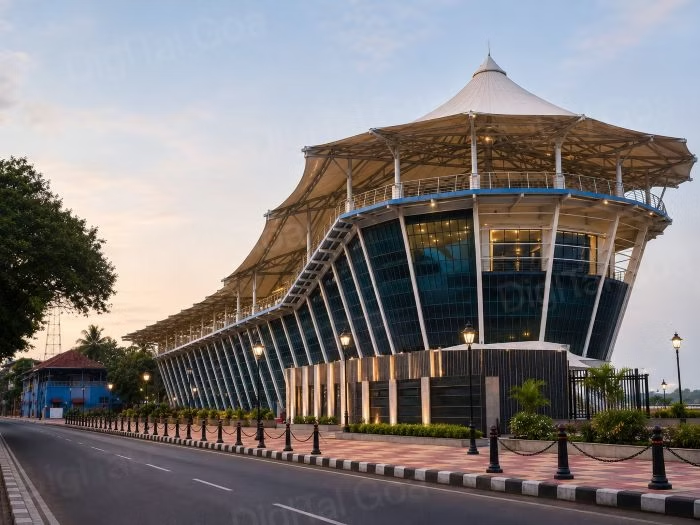
Goa’s new ₹48.87 crore Captain of Ports Terminal is more than an administrative building. It represents a strategic shift in how the state views its rivers, ports and waterways as engines of transport, tourism and economic growth at a time when the transition to a Goa Maritime Board and the proposed Water Metro are gathering momentum.
At a Glance
- Goa has inaugurated its new Captain of Ports Terminal on the Mandovi riverfront.
- The project has been built at a cost of approximately ₹48.87 crore.
- The three-storey terminal spans about 4,405 square metres and will serve as the headquarters of the Captain of Ports Department.
- The development comes as Goa prepares to establish its own Maritime Board under the Indian Ports Act, 2025.
- The terminal is expected to support future maritime governance, ferry operations, coastal transport and long-term plans such as the proposed Water Metro.
Goa’s Rivers Are About to Mean More Than Beautiful Views
For generations, Goa’s rivers have shaped the state’s identity.
The Mandovi and Zuari carried spices before highways existed. Ferries connected villages long before bridges transformed daily travel. Fishing communities, traders and tourists have all depended on these waterways in different ways.
Yet over the last three decades, public investment largely shifted towards roads.
Every new bridge solved one problem while creating another. Vehicle ownership increased rapidly. Tourist arrivals continued to grow. Peak season traffic became an accepted part of daily life. Roads became busier, even as the rivers that once connected Goa remained an underutilised transport asset.
Across India, states are rediscovering inland waterways as cleaner and more efficient transport corridors. Kerala’s Water Metro has demonstrated that rivers can complement roads instead of competing with them. National policy has increasingly emphasised ports, coastal shipping and inland navigation as pillars of economic development.
Goa’s latest investment fits into this larger transformation.
Beyond a New Building, Goa Is Reimagining Its Maritime Future
Officially, the new Captain of Ports Terminal becomes the operational headquarters of the Captain of Ports Department.
Constructed at a cost of nearly ₹49 crore, the facility stands on the Mandovi riverfront with a built-up area of roughly 4,405 square metres. Designed in the form of a modern vessel, it brings together administrative offices and operational facilities under one roof while creating improved passenger infrastructure for ferry users and maritime visitors.
But describing it simply as an office building misses the larger story.
Infrastructure often signals policy direction.
Airports encourage aviation.
Metro stations reshape urban development.
Ports stimulate trade.
Similarly, modern maritime terminals create the physical foundation necessary for expanding water transport.
Without terminals, passenger facilities, navigation systems and administrative capacity, ambitious ideas such as a Water Metro remain conceptual.
The Captain of Ports Terminal therefore represents foundational infrastructure.
It strengthens the state’s ability to manage ferry services, coordinate maritime operations and prepare for future expansion in water-based mobility.
It also arrives alongside the state’s transition towards establishing a Goa Maritime Board under the provisions of the Indian Ports Act, 2025, signalling broader institutional reforms in maritime governance.
The Captain of Ports Department is among Goa’s oldest government institutions.
Its origins stretch back to Portuguese administration, when maritime governance centred on ports, navigation and river traffic.
For decades, the department has regulated ferry services, inland navigation, port operations and safety across Goa’s waterways.
Today, however, maritime governance is evolving nationally.
The Indian Ports Act, 2025 requires states to establish Maritime Boards that oversee port development through integrated planning rather than traditional departmental administration.
Goa has already initiated this transition.
The state government has confirmed that drafting work for the Goa Maritime Board is underway. Until the Board is formally constituted, the Captain of Ports Department continues to function under provisions permitted by the new legislation.
The terminal therefore becomes symbolic for another reason.
It is not simply the headquarters of an existing department.
It is likely to become the operational centre of Goa’s next generation of maritime governance.
Infrastructure is often judged by what people can see. Citizens notice a new bridge, a widened highway or a modern terminal. But the real value of public infrastructure lies in what people experience years later.
The new Captain of Ports Terminal has the potential to improve daily life in ways that extend far beyond its immediate location on the Mandovi riverfront.
For commuters, stronger maritime infrastructure creates the possibility of faster and more reliable ferry services as future investments expand water-based mobility. For residents living along Goa’s rivers, it reinforces the importance of waterways that have historically connected communities but have received relatively little modern investment.
Tourism also stands to benefit. Visitors increasingly seek experiences beyond beaches, and river cruises, water taxis and ferry-based sightseeing have become attractive offerings in destinations around the world. Better passenger facilities can improve first impressions while creating opportunities for private operators to expand services.
The economic effects are equally significant. Infrastructure investment typically generates demand for construction, operations, maintenance, hospitality and transport-related businesses. Waterfront development often encourages restaurants, recreational activities and commercial services that benefit surrounding communities.
Environmental benefits may emerge over the longer term if water transport successfully shifts a portion of passenger movement away from already congested roads. Inland waterways generally consume less energy per passenger kilometre than equivalent road transport, particularly when supported by cleaner vessel technologies.
Perhaps most importantly, the project changes how Goans may begin to think about their rivers. Instead of viewing them primarily as scenic assets or geographical barriers, they become public infrastructure capable of supporting everyday life.
The Goa Government has consistently framed the project as more than a standalone infrastructure investment.
Speaking about the transition from the Captain of Ports Department to a State Maritime Board, Ports Minister Subhash Phal Dessai said the government has already begun drafting the necessary rules under the Indian Ports Act, 2025. The objective is to create a modern maritime governance framework that brings port development, coastal infrastructure and inland waterways under a more integrated institutional structure.
Officials have also maintained that the Captain of Ports Department continues to function lawfully while the transition is underway, rejecting suggestions that there is any legal vacuum following the implementation of the new legislation. The department has stated that a proposal has already been submitted to notify it as the State Maritime Board until a dedicated board is constituted.
The government has further clarified that the new terminal received all required statutory approvals, including Coastal Regulation Zone clearance, pollution control approvals and utility permissions. Officials stressed that the structure was constructed on piles without river reclamation, making it compliant with applicable coastal regulations.
Taken together, these statements present the terminal as part of a broader effort to modernise maritime governance while preparing Goa for future investments in ports, passenger transport and coastal infrastructure. Its river network is naturally embedded within populated and economically active areas.
The challenge now lies in converting this geographic advantage into an efficient public transport system supported by strong governance and sustained investment.
Experts also point to the importance of developing the wider blue economy. Modern maritime infrastructure can support marine tourism, logistics, fisheries, recreational boating and waterfront businesses, creating economic activity that extends well beyond passenger transport.
The Captain of Ports Terminal therefore represents an important beginning.
Whether it becomes a landmark building or the foundation of a transformed transport network will depend on the policy decisions that follow.