
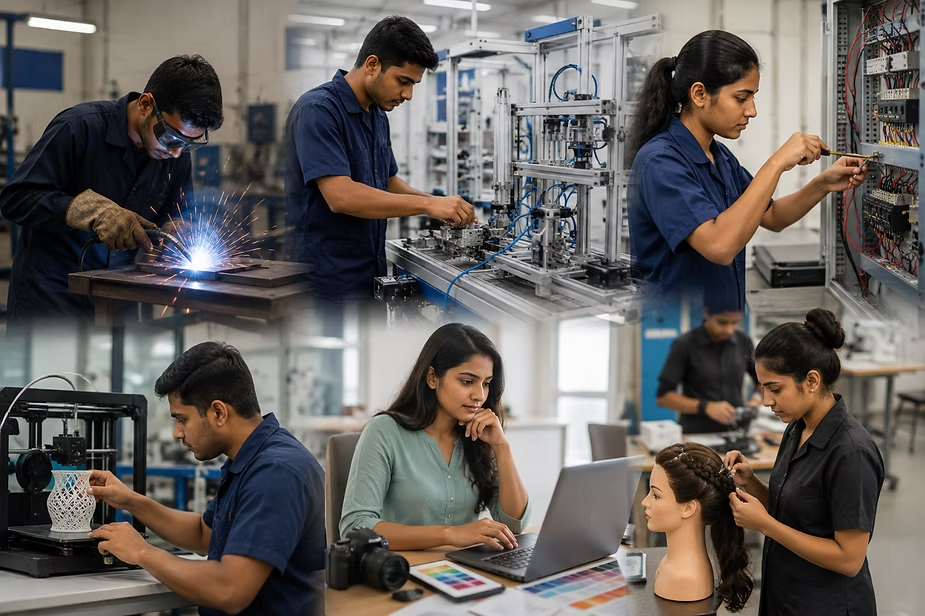
A degree may open the door, but today’s job market increasingly demands specialised skills. Goa’s Chief Minister’s Kaushal Path Scheme is built around that reality – offering young people shorter, flexible training programmes designed to help them learn, upgrade and adapt as industries change. From advanced welding and industrial automation to digital marketing and 3D printing, the growing range of courses reflects a shift towards practical skills, targeted and responsive to new opportunities.
There’s a familiar gap in every changing economy: education gives people a qualification, but employment often requires something more specific.
A graduate may need digital skills to enter a new industry. A technician may need to upgrade their knowledge as technology changes. Someone already working may need an additional qualification to move ahead. For young people looking for a quicker entry into employment, committing to another long-term course may not always be an option.
That is the space Goa’s Chief Minister’s Kaushal Path Scheme (CMKPS) is designed to fill.
Launched in April 2023, the scheme offers an alternative to the traditional one-size-fits-all approach to vocational education. Its focus is on skilling, reskilling and upskilling through shorter and more flexible programmes that can respond to changing industry requirements. The idea is straightforward: as the economy changes, the skills required to participate in it must change too.
Also Read: Also Read: Goa Government Opens New Doors for Inclusion, Access and Independence
A Growing Pathway for Skills and Opportunity
Though relatively new, the Chief Minister’s Kaushal Path Scheme is steadily expanding its reach and creating more opportunities for young people to access short-term, employment-oriented training. According to the Economic Survey 2025–26, CMKPS covered 58 beneficiaries in 2023–24, followed by 383 beneficiaries in 2024–25, with another 291 beneficiaries covered up to December 2025.
These figures reflect the scheme’s growing role in Goa’s skill-development ecosystem, providing a dedicated pathway for young people to acquire practical and industry-relevant skills alongside conventional education and vocational training.
The approach is not about replacing degrees or long-term technical education. Instead, it recognises that learning does not end when someone receives a certificate or enters the workforce. In a labour market shaped by technology, automation and changing consumer demand, opportunities to learn new skills and upgrade existing ones are becoming increasingly important.
That is where CMKPS fits in – creating a flexible pathway for individuals to continue learning and prepare for new opportunities as the economy evolves.
From traditional trades to the technologies of tomorrow
The strongest indication of the scheme’s approach lies in its course basket.
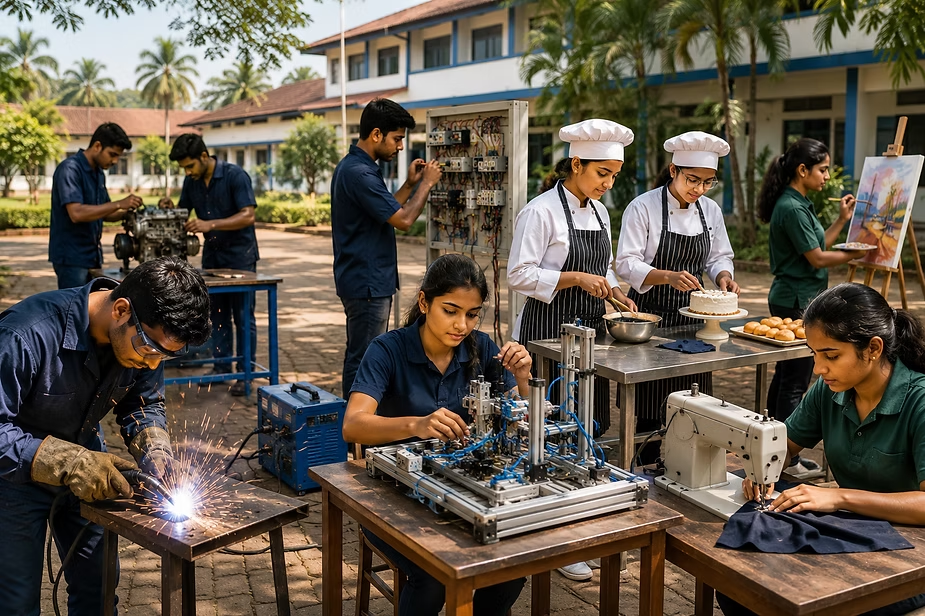
The programmes offered under CMKPS move across a remarkably broad range of sectors. There are traditional and technical trades such as welding, electrical work, refrigeration and air-conditioning, vehicle mechanics and electronics repair. There are digital and technology-oriented courses in digital marketing, graphic design, computer programming, industrial automation, and 3D printing and designing.
Then there are courses linked to emerging opportunities in solar panel repair and maintenance, wastewater treatment plant operations and fire and safety, alongside creative and enterprise-oriented skills such as photography, cosmetology, bakery, jewellery-making and sewing.
Agriculture and livelihood-based skills also find a place, including oyster mushroom cultivation, grafting and decorative plants, and landscaping and bonsai.
That diversity matters because Goa’s economy does not create opportunities in just one sector. A young person looking for a technical job needs a different skill set from someone planning to start a small creative enterprise. Someone working in tourism or services may need different training from someone entering manufacturing or agriculture.
CMKPS attempts to respond to that diversity rather than directing every learner towards the same vocational pathway.
Also Read: From Skills to Jobs: How Goa Is Building an Inclusive Future for All
Shorter courses, faster pathways
One of the scheme’s defining features is its emphasis on shorter-duration programmes.
For many young people, the challenge is not a lack of willingness to learn but the time and resources required to pursue another lengthy course. Someone who already has a qualification may simply need one additional skill. Someone seeking employment may need practical training that helps them become job-ready faster. Someone already working may want to upgrade without stepping away from their career for an extended period.
Short-term training creates space for all three.
The model allows learning to become more targeted: acquire a new skill, strengthen an existing one, or adapt to a changing industry requirement. Instead of treating skill development as a one-time stage before employment, it recognises that continuous learning is becoming part of modern working life.
Recognition for governance and skill development
CMKPS has also received recognition for its contribution to governance and skill development. The scheme was awarded the SKOCH Gold Award 2025 on January 10, 2026, adding external recognition to a programme that has steadily expanded since its launch.
The award is significant because skill development is increasingly being viewed as more than a training exercise. For states looking to build competitive economies, the quality and adaptability of the workforce can determine whether new opportunities translate into local employment.
Goa’s challenge is therefore not simply to create jobs, but to ensure that its young people have the skills required to access them.
What it means for Goan youth
For Goan youth, CMKPS provides vital flexibility in skill development. While a degree offers a base, specialized practical skills often determine job readiness in a digital economy.
By combining traditional trades, modern technologies, digital expertise, and livelihood training, CMKPS creates diverse pathways for different ambitions. It recognizes that education no longer offers a single route to employment; youth may pursue higher studies, enter technical fields, launch enterprises, or upskill as industries evolve.
As it expands, CMKPS shifts workforce development toward adaptable, practical learning aligned with economic shifts—fostering continuous learning as the ultimate career skill.
Also Read: Atal Tinkering Labs: Goa Prioritises Innovation and Future-Ready Learning in Schools