


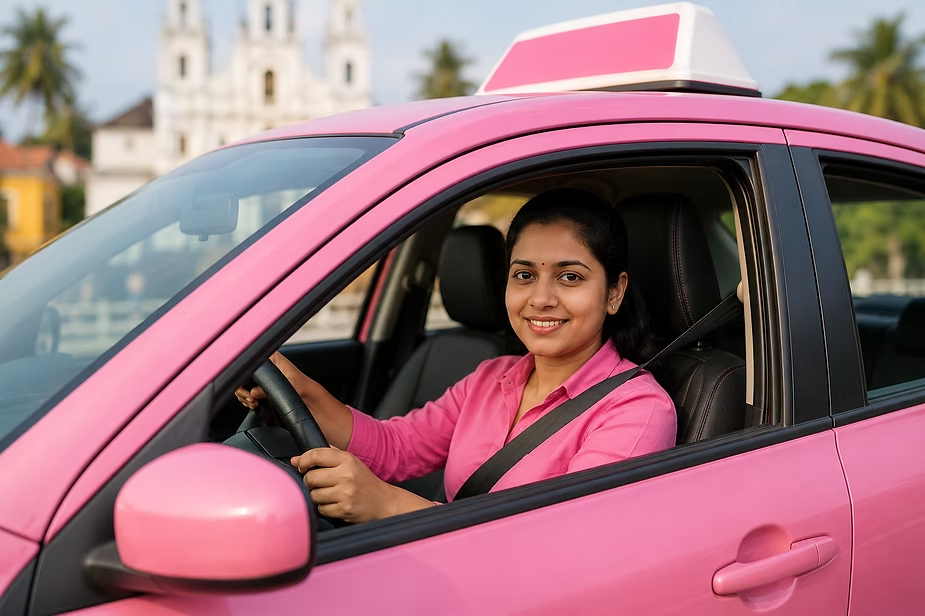
Goa may soon witness another women-centric mobility initiative if discussions currently underway within the government translate into policy action. Following the introduction of women-driven Pink Rickshaws and building on earlier women-focused transport services, the state is now exploring the possibility of introducing Pink Taxis operated by women under a cooperative framework. While the proposal remains at the discussion stage, it represents an important policy conversation at the intersection of women’s empowerment, public mobility, entrepreneurship and inclusive economic growth.
The idea of women-operated transport services is not entirely new to Goa. More than a decade ago, the Goa Tourism Development Corporation introduced a women-driven taxi service aimed at providing safe transportation options for women travellers and tourists. The service featured women drivers trained in self-defence, first aid, customer service and tourist guidance, with vehicles equipped with GPS tracking and emergency response systems. The initiative was among the earliest examples of women-led public mobility services in the state and demonstrated that transport could become a viable avenue for female entrepreneurship in Goa.
More recently, the state government promoted the Pink Rickshaw initiative, a programme intended to create self-employment opportunities for women while increasing their participation in the transport sector. In 2022, Chief Minister Pramod Sawant announced that women would be trained and supported through financing mechanisms such as the Chief Minister’s Rozgar Yojana, with assistance from the Economic Development Corporation and Rotary Club partnerships. At the time, around 17 women were reported to be undergoing training while the first fleet was expected to comprise approximately 14 women drivers.
The proposed Pink Taxi initiative appears to be a natural evolution of this broader policy direction. Although official details are still emerging, discussions indicate that the concept may be developed through a cooperative structure that enables women to collectively participate in the taxi sector. Such a model could potentially reduce entry barriers for women interested in joining the transport industry while creating opportunities for self-employment and financial independence.
The significance of the proposal becomes clearer when viewed against the backdrop of women’s participation in traditionally male-dominated occupations. Across India, commercial driving remains overwhelmingly male. Transport services, whether taxis, auto-rickshaws, buses or logistics operations, have historically seen limited female participation due to social norms, safety concerns, access to financing and lack of training opportunities. Policy interventions that encourage women to enter these sectors are increasingly being viewed as tools for economic inclusion rather than merely social welfare programmes.
For Goa, the proposal carries implications beyond employment generation alone. Mobility forms a critical part of the state’s tourism-driven economy. Every year, millions of visitors depend on taxis and transport services to move between airports, railway stations, hotels, beaches and tourist attractions. Creating a women-led taxi segment could potentially diversify transport offerings while simultaneously creating new opportunities for local women entrepreneurs.
The proposal also arrives at a time when Goa is engaged in broader discussions about the future of its taxi ecosystem. The government has been exploring digital taxi policies and app-based platforms aimed at improving accessibility, transparency and service delivery. These discussions have generated significant debate among stakeholders, including taxi operators and transport associations. The introduction of a Pink Taxi cooperative could potentially become part of this wider effort to modernise mobility services while ensuring that economic opportunities remain accessible to local communities.
Supporters of the Pink Taxi concept argue that it could serve multiple policy objectives simultaneously. The first is economic empowerment. Ownership or operation of commercial vehicles provides a direct source of income and allows women to participate as entrepreneurs rather than employees. If supported through low-interest loans, subsidies or cooperative financing structures, the initiative could create a pathway for women who may otherwise face challenges accessing traditional business opportunities.
The second objective relates to visibility and representation. Women drivers remain relatively uncommon in public transport systems across much of India. Increasing their presence can help challenge stereotypes around gender roles while demonstrating that mobility services are a viable profession for women. Such visibility often creates a multiplier effect, encouraging more women to consider careers previously regarded as inaccessible.
A third potential benefit lies in expanding mobility choices. While the proposed service has not yet been formally designed, women-driven taxi services in other parts of India have often been positioned as an additional option for women passengers, senior citizens and families. The objective is generally not to replace existing transport systems but to provide an alternative service model that some users may prefer.
Examples from other states offer useful lessons for Goa as policymakers consider the proposal. Kerala’s She Taxi initiative, launched with the support of the state’s Department of Social Justice, sought to create a fleet owned and operated by women with a focus on safe and secure transportation. Similarly, women-led cab services in cities such as Bengaluru have incorporated specialised driver training, GPS monitoring, emergency response systems and digital booking platforms. These initiatives demonstrate that women-focused mobility programmes can function effectively when supported by adequate training, technology and market demand.
At the same time, experiences from across India also highlight important challenges. Several Pink Auto and Pink Rickshaw initiatives introduced in different cities have struggled with long-term sustainability. Some faced difficulties because of limited ridership, while others encountered competition from app-based mobility platforms. In certain locations, operators found it difficult to generate sufficient income if services were restricted to specific passenger segments. These experiences underline the importance of designing a financially viable model from the outset.
For Goa, sustainability may ultimately depend on how the proposed scheme is structured. Policymakers will need to determine whether drivers will own vehicles individually or operate through a cooperative model. Questions surrounding financing, insurance, maintenance costs, training requirements and digital booking systems will all influence the viability of the initiative. Integration with broader transport policies could also play an important role in determining whether the service attracts sufficient demand.
Technology is likely to become another critical component. Across India, passengers increasingly expect app-based booking, transparent pricing, GPS tracking and digital payments. Any future Pink Taxi network would likely need to incorporate these features to remain competitive within an evolving mobility landscape. Goa’s ongoing discussions around digital taxi platforms suggest that future transport reforms may increasingly rely on technology-driven solutions.
The proposal also reflects a wider shift in governance thinking. Modern welfare and empowerment programmes increasingly focus on creating opportunities rather than providing assistance alone. Instead of viewing women primarily as beneficiaries, contemporary policy frameworks seek to position them as entrepreneurs, service providers and economic contributors. A well-designed Pink Taxi initiative would align closely with this approach by enabling women to participate directly in a key sector of the state’s economy.
For the tourism industry, the initiative could offer additional value. Goa’s tourism brand has long depended not only on its natural attractions but also on visitor experience. Professional, technology-enabled and women-led mobility services could contribute to a more diverse transport ecosystem while creating employment opportunities for local residents. However, achieving these outcomes would require careful implementation and sustained support rather than relying solely on symbolic branding.
Several questions remain unanswered because the proposal is still under discussion. How many taxis would be included in the initial phase? What financial assistance would be available? Would drivers receive specialised training? Would the service operate statewide or begin in specific urban centres? Would it be integrated into a digital booking platform? These details will ultimately determine whether the proposal evolves into a scalable and sustainable programme.
For now, the Pink Taxi initiative should be viewed as an emerging policy idea rather than a completed achievement. Yet the conversation itself is significant. It signals an effort to explore new avenues for women’s participation in Goa’s economy while addressing mobility needs through innovative approaches. If implemented effectively, the initiative could build upon the foundations laid by Goa’s earlier women-driven transport programmes and create a new chapter in the state’s journey towards inclusive growth.
As discussions continue, the proposal offers an opportunity to rethink the relationship between mobility, entrepreneurship and empowerment. Whether the Pink Taxi concept eventually becomes a statewide service or remains a policy proposal will depend on the framework ultimately adopted. What is already clear, however, is that the idea has opened an important conversation about who participates in Goa’s transport economy and how future opportunities can be made more inclusive for women across the state.