



A new concessional-credit push could make higher education outside Goa more accessible, building on the state’s existing interest-free education loan and scholarship ecosystem.
The Goa Student Who Wants To Leave, Study And Come Back
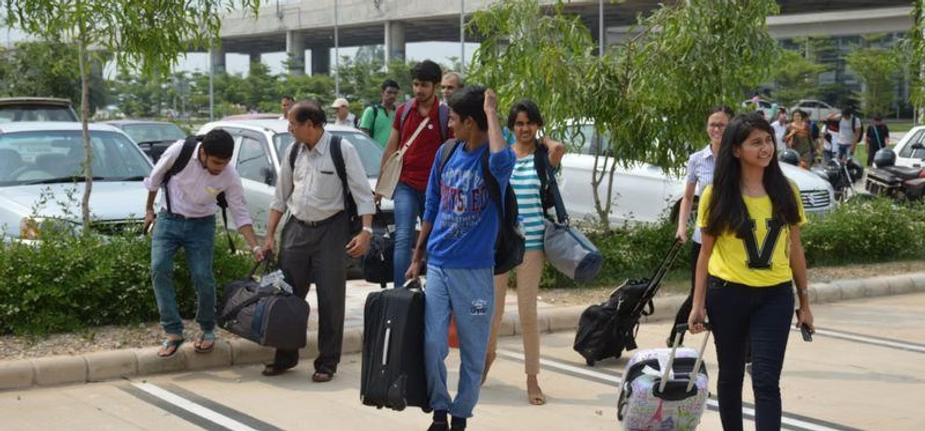
For a student in Goa, leaving the state for college is often less about wanting to leave home and more about finding the course, institution or opportunity that Goa cannot offer.
That reality is increasingly visible. Students from the state have been choosing cities outside Goa for wider course options, exposure, faculty and industry opportunities. A 2024 report by The Times of India documented this trend among undergraduate students.
Now, Chief Minister Pramod Sawant has announced a 4% education-loan facility for ST and OBC students pursuing higher education outside Goa, according to the announcement on which this report is based.
The significance lies in the financing question.
What Happened: A Lower-Cost Route To Higher Education
The reported announcement targets students from Scheduled Tribe and Other Backwards Classes communities who need financial support to pursue higher education outside the state.
The 4% figure matters because education loans can become a significant financial burden when tuition, accommodation, travel and other costs accumulate over several years.
Goa already has a substantial education-finance framework. Its Interest Free Education Loan Scheme, implemented through the Goa Education Development Corporation, is designed to support approved undergraduate and postgraduate degree and diploma courses in India and abroad. The scheme exempts borrowers from interest when they follow the prescribed repayment schedule.
Why It Matters: The Course May Be Outside Goa
The strongest case for such support is simple. The opportunity may not be available locally.
Goa’s own education-loan framework recognises this reality. It allows eligible students to pursue approved higher and technical education in India or abroad, while its eligibility provisions provide specific relaxations for SC, ST and OBC candidates.
The state also operates a fee-waiver scheme for eligible SC and ST students pursuing higher education, covering tuition, library, laboratory and development fees.
This creates a wider policy architecture: scholarships, fee support and concessional credit are being used at different stages to reduce the cost barrier to higher education.
Read Also: Goa’s Kunbi Weaving Legacy Continues on National Handloom Day
Sawant’s Education Push: Beyond One Loan
The reported 4% announcement sits within a broader education agenda under the Sawant government.
The Chief Minister’s Scholarship Portal brings together scholarship and assistance schemes from multiple departments on a single platform. Its current listings include the Interest Free Education Loan Scheme alongside scholarships for ST, SC and OBC students.
The government has also retained the Interest Free Education Loan Scheme as part of its current higher-education framework. The Directorate of Higher Education lists it among its active schemes, while GEDC is accepting applications for the 2025-26 cycle.
That makes the latest announcement less about creating education finance from scratch and more about expanding the range of affordable financing available to specific groups.
The Background: Goa Already Had A Head Start
Goa’s Interest Free Education Loan Scheme dates back to 2005, according to GEDC. The government says the scheme was created to ensure financial constraints do not prevent young Goans from pursuing higher and technical education.
The 2023 notified framework allowed loans of up to ₹2 lakh per year for studies in India, subject to a maximum of ₹10 lakh over five years, and up to ₹8 lakh per year for studies abroad, subject to a maximum of ₹16 lakh over two years.
A 2026 government notification also shows that Goa continues to actively administer the Interest Free Education Loan Scheme.
The Category-Specific Credit Route
There is another layer.
Goa’s State Scheduled Castes and Other Backward Classes Finance and Development Corporation acts as a state channelising agency for national finance corporations including NSFDC and NBCFDC.
Government material has previously documented a 4% NSFDC education loan for eligible Scheduled Caste students, including higher education in India and abroad.
The exact terms of the newly reported ST and OBC facility, however, need to be read alongside the formal notification when issued.
What Happens Next
The next important document is the detailed government notification or implementing guidelines. That will establish whether the announcement represents a new standalone facility, an expansion of an existing category-specific loan arrangement, or a revised financing structure operating alongside Goa’s Interest Free Education Loan Scheme.
For students, that distinction matters.
Because ultimately, the measure will not be judged by the number printed in a government announcement. It will be judged by whether a student from Goa can receive the money in time, enter the institution they earned admission to and pursue the course that could change their future.
Read Also: 18,575 Goan artisans benefit from PM Vishwakarma Scheme