


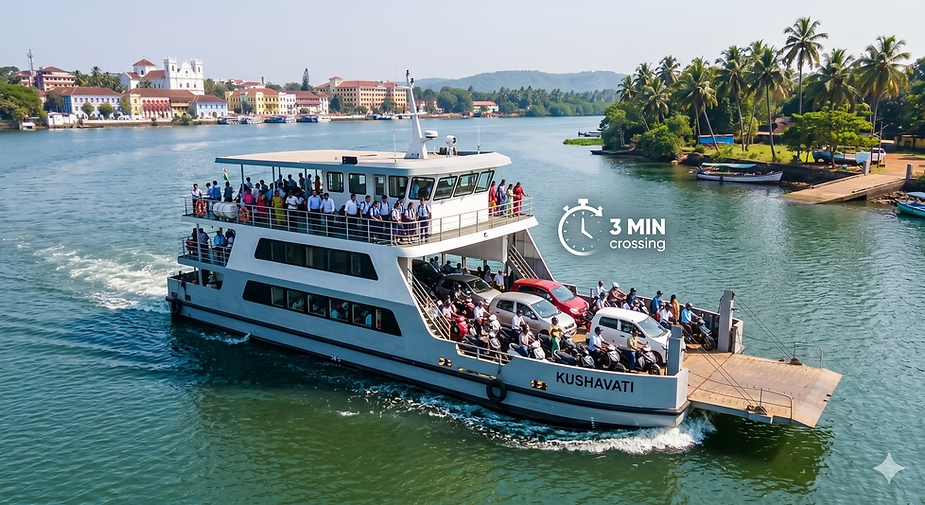
Panaji and Betim have always shared one of Goa’s busiest daily commuter routes. Every day, office-goers, students, tourists, transport workers, and local residents move between the two sides of the Mandovi River, often dealing with traffic congestion, fuel costs, and delays on road routes. While the distance itself is short, peak-hour movement through road infrastructure can sometimes become slow and frustrating for regular commuters.
Now, Goa is strengthening one of its oldest and most practical transport systems with the launch of two modern ferries Kushavati and Salaulim. The new ferries are designed to make travel across the Mandovi faster, smoother, and more efficient for both residents and visitors. What makes this especially significant is that the Panaji-to-Betim crossing can now be completed in approximately three minutes, offering a quick and reliable alternative to congested roads.
For Goa, ferries are not just a tourist attraction. They are part of the state’s everyday mobility system and have historically played an important role in connecting communities across rivers and waterways. Even today, ferries remain one of the most affordable and efficient forms of public transport for many people living near river crossings.
The launch of larger and more modern ferries represents an effort to upgrade this traditional system for present-day needs. With increasing vehicle ownership, expanding urban movement, and rising fuel consumption, improving water-based transport infrastructure has become both practical and necessary. The new ferries are aimed at reducing waiting time, easing traffic pressure, and improving commuter comfort during daily travel.
Each ferry is capable of carrying around 150 passengers along with multiple vehicles, allowing more people to cross efficiently during busy hours. This higher carrying capacity is expected to improve operational flow while reducing long queues that commuters often experience during peak travel periods.
The upgraded ferry system also contributes to a larger conversation around sustainable urban mobility. Across Bharat, governments and urban planners are increasingly focusing on reducing road congestion, lowering fuel consumption, and improving public transportation systems. Goa’s river ferry network naturally fits into this approach because it uses existing waterways to move people and vehicles efficiently without adding additional pressure on roads.
In practical terms, more people using ferries can mean fewer vehicles idling in traffic, lower fuel usage, reduced travel stress, and smoother movement across the city. Even small improvements in daily commute systems can have a noticeable impact on quality of life over time, especially in busy urban areas where travel delays affect thousands of people every day.
For tourists, the modern ferry experience also adds another dimension to exploring Goa. Instead of viewing ferries purely as transport, many visitors increasingly see them as part of the Goan experience itself — offering scenic river views, open-air travel, and a more relaxed pace compared to road traffic. The Mandovi crossing provides a unique perspective of Panaji’s waterfront while also serving an important functional purpose.
The emphasis on comfort and efficiency reflects a broader governance shift towards improving everyday public infrastructure rather than focusing only on large-scale projects. Small but effective upgrades in transport systems often have direct and visible benefits for citizens. Better ferry operations can improve punctuality, reduce commuter fatigue, and make short-distance travel significantly more convenient.
The launch of Kushavati and Salaulim also signals continued investment in Goa’s water transport ecosystem. As traffic volumes continue to increase across urban centres, ferries can become an even more important part of integrated mobility planning within the state. Goa’s geography, shaped by rivers and coastal networks, naturally creates opportunities for strengthening water-based transportation systems in ways many other states cannot easily replicate.
Importantly, ferry services also support inclusivity in public transport. They remain accessible to daily wage workers, local residents, students, office commuters, and tourists alike. Affordable and efficient mobility systems are critical for balanced urban development, and ferries continue to play that role in Goa even as infrastructure modernises.
At a time when discussions around fuel conservation and smarter transportation are becoming more important nationally, Goa’s ferry upgrades demonstrate how local infrastructure improvements can contribute to larger sustainability goals. Reducing dependency on road-heavy movement, especially for short crossings, can gradually support lower congestion and more efficient urban travel patterns.
The Panaji-Betim ferry route may appear like a small part of Goa’s transport network, but for thousands of daily commuters, small improvements often create the biggest difference. Saving travel time, reducing waiting periods, and improving comfort during everyday movement directly impacts people’s routines and productivity.
What stands out most about the new ferry launch is that it improves something people already use regularly. Instead of introducing an entirely new system, the focus has been on upgrading an existing public service and making it more efficient for present-day needs. That makes the change immediately visible and relatable to commuters.
For many Goans, ferries are deeply connected to daily life and local identity. Modernising them while preserving their accessibility reflects a blend of tradition and practical governance. The result is a transport solution that feels both familiar and future-ready at the same time.
The three-minute crossing between Panaji and Betim is therefore about more than speed alone. It represents a smarter way of moving through the city — one that is efficient, practical, environmentally conscious, and rooted in Goa’s own geography and lifestyle.
Sometimes, the most effective infrastructure upgrades are not the loudest ones. They are the changes people quietly experience every single day while getting to work, returning home, or crossing the river with ease.