


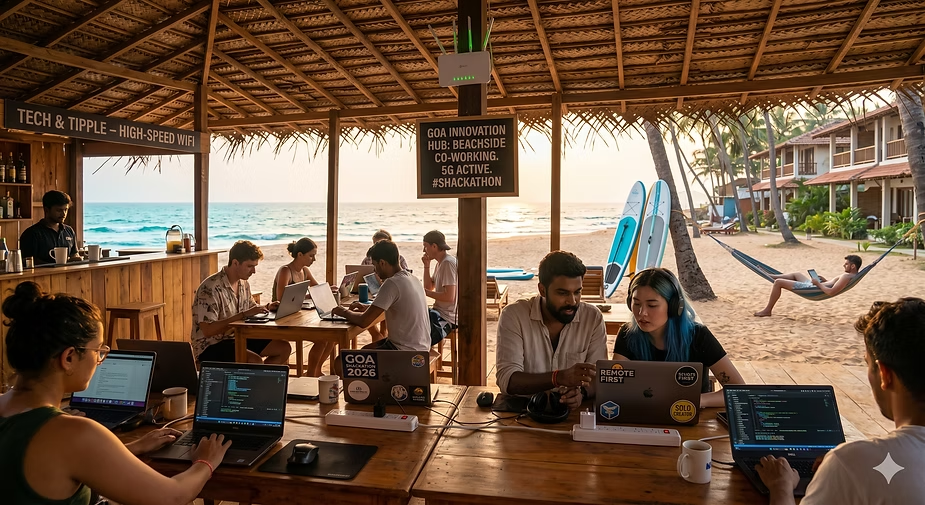
A quiet shift is unfolding across Goa not just in its economy, but in the very rhythm of everyday life. In cafés tucked into the lanes of Assagao, laptops now sit beside cups of artisanal coffee. In beachside shacks once associated only with tourism and nightlife, developers are building software products, startup founders are pitching ideas over Zoom calls, and content creators are managing global audiences from the edge of the Arabian Sea.
For decades, professional success followed a predictable route. Young graduates migrated to crowded metropolitan cities like Bengaluru, Mumbai, Hyderabad, or Pune, chasing opportunities inside glass office towers and sprawling corporate campuses. Long commutes, rigid office schedules, and relentless burnout became accepted as the unavoidable price of ambition.
That formula is rapidly collapsing.
The global workforce is undergoing one of the most dramatic transformations in modern economic history. Remote work, hybrid employment models, creator economies, startup ecosystems, and digital entrepreneurship are fundamentally redefining how people think about careers. Increasingly, professionals are prioritizing flexibility, mental well-being, lifestyle quality, and creative freedom alongside income and career growth.
And Goa is positioning itself directly at the center of this global shift.
What was once viewed almost exclusively as a tourism destination is now emerging as one of Bharat’s most fascinating experiments in future-ready economic development. Through strategic policy interventions, aggressive digital infrastructure upgrades, startup support systems, and lifestyle-driven innovation, Goa is evolving into a destination where technology, creativity, entrepreneurship, and quality of life coexist seamlessly.
This transformation is not accidental. It is increasingly becoming part of a larger economic vision.
The COVID-era remote work transition accelerated trends that were already quietly developing across the global economy. What began as temporary work-from-home arrangements has now matured into a permanent restructuring of labor markets worldwide. Companies are no longer restricting hiring to specific geographies. Teams are distributed across countries and time zones. Startups are being built entirely remotely. Digital creators are operating global businesses without centralized offices.
The implications of this shift are enormous.
According to global market estimates, the digital nomad economy was valued at nearly 44 billion dollars in 2025 and is projected to cross 54 billion dollars in 2026 alone. Long-term forecasts suggest that location-independent work could become mainstream for hundreds of millions of professionals globally by 2035. Increasingly, people are asking a different question altogether: instead of moving where the jobs are, why not work from where life feels better?
Goa offers an answer few destinations can match.
Unlike congested metros battling pollution, long commute hours, housing stress, and severe burnout culture, Goa presents an entirely different proposition. It combines lifestyle with infrastructure. Nature with connectivity. Creativity with community. Professionals no longer have to choose between career growth and personal well-being.
This changing demographic landscape is already visible across the state.
Remote-first startups are temporarily relocating teams to Goa for collaborative work sprints. Freelancers are building international businesses from quiet villages in North Goa. Designers, developers, writers, consultants, and creators are integrating work into a slower, healthier lifestyle. Corporate employees using hybrid work policies are splitting their time between metro headquarters and long-term stays in Goa.”Goa is steadily emerging as India’s work-from-beach destination, driven by changing aspirations of the younger generation who now seek flexibility, creativity, and purpose alongside work.” — Pramod Sawant, Chief Minister of Goa
The result is the emergence of a completely new economic layer operating alongside traditional tourism.
What makes this evolution particularly significant is that Goa is not merely becoming a passive backdrop for remote workers. The state is actively adapting itself to support this transformation.
The physical architecture of Goa itself is changing in response to the future of work.
Beach cafés that once catered almost exclusively to tourists are redesigning spaces around productivity. Plug points, ergonomic seating, reliable internet connectivity, quiet work corners, and extended daytime operations are becoming standard features. The casual café culture of places like Assagao, Anjuna, and Vagator is increasingly blending with startup culture and collaborative workspaces.
Even more symbolic is the rise of co-working beach shacks and open-air productivity spaces. These unconventional environments are reshaping the traditional idea of an office itself. The modern professional is no longer confined to sterile cubicles and fluorescent lighting. Work is becoming more fluid, decentralized, and community-oriented.
The shift extends into real estate as well.
Property owners and hospitality businesses are moving beyond short-term tourism models and investing in long-stay rentals, co-living spaces, and hybrid accommodation designed specifically for remote professionals. Unlike traditional tourists who may stay for a weekend, digital professionals often remain for months, contributing consistently to the local economy.
This distinction is economically important.
A traditional tourist spends intensely but briefly. A remote professional integrates more deeply into the ecosystem. They rent apartments, subscribe to broadband services, join gyms, work from cafés daily, use local transportation, purchase groceries, participate in wellness programs, and support local businesses year-round. This creates a more stable, sustainable economic cycle that is less vulnerable to seasonal fluctuations.
Recognizing this opportunity early, Goa’s leadership has begun actively aligning policy with the future economy.
One of the clearest examples of this strategy is the Goa Shackathon initiative launched by the Department of Information Technology, Electronics and Communications. The concept itself perfectly captures the evolving identity of the state. Instead of hosting innovation events inside conventional conference halls, the initiative transforms iconic Goan beach shacks into collaborative technology workspaces for developers, creators, and startup founders.
The symbolism matters.
It signals that Goa is not trying to imitate Bengaluru or Hyderabad. Instead, it is building its own distinctive innovation identity — one rooted in creativity, openness, flexibility, and lifestyle integration.
The Shackathon is more than an event. It represents a broader economic philosophy.
By actively encouraging startup culture, remote work ecosystems, and innovation-driven communities, Goa is diversifying its economy beyond traditional mass tourism. This diversification carries major long-term implications for the state.
One of the most important impacts is the potential reversal of brain drain.
For years, many of Goa’s brightest students graduated from institutions such as Goa Engineering College and National Institute of Technology Goa only to leave the state in search of technology opportunities elsewhere. The lack of a large-scale innovation ecosystem forced young professionals to migrate toward metro cities.
That pattern is beginning to shift.
As startups, founders, investors, and remote work ecosystems increasingly flow into Goa, local youth no longer need to leave the state to participate in the global technology economy. The ecosystem is gradually coming to them instead.
This creates localized opportunities in software development, digital media, AI-driven services, design, hospitality-tech, creator businesses, and innovation consulting. It also exposes local students and entrepreneurs to global professional networks without requiring migration.
The broader infrastructural response from the state is equally significant.
Reliable internet connectivity is now treated as foundational infrastructure rather than a luxury. Expansion of 4G and 5G networks, increasing public Wi-Fi availability, and digital service upgrades are critical components of Goa’s long-term competitiveness in the remote work economy.
Transportation infrastructure also supports this transition. Connectivity through Manohar International Airport and Dabolim Airport, alongside highway upgrades and improving mobility networks, allows professionals to move fluidly between Goa and major Indian business centers.
Importantly, Goa’s appeal extends beyond logistics and economics. It offers something increasingly scarce in modern professional life: balance.
Globally, burnout is becoming one of the defining crises of contemporary work culture. Long work hours, digital fatigue, isolation, and relentless productivity pressure have led professionals worldwide to reconsider their relationship with work itself.
Goa presents an alternative model.
Here, productivity coexists with wellness. Work meetings are followed by evening walks along the coastline. Yoga studios operate alongside startup hubs. Community interaction replaces anonymous metropolitan isolation. Professionals are discovering that creativity and innovation often flourish more naturally in environments that support mental clarity and emotional balance.
This psychological dimension is one of Goa’s greatest competitive advantages.
Destinations like Bali, Chiang Mai, and Lisbon became global digital nomad hubs precisely because they offered an escape from hyper-stressed urban professional ecosystems. Goa possesses many of the same advantages while simultaneously benefiting from its integration into Bharat’s rapidly expanding digital economy and engineering talent ecosystem.
However, the transition is not without challenges.
Rapid migration of remote workers and high-income professionals can place pressure on housing affordability, local infrastructure, waste management systems, traffic networks, and community integration. If unmanaged, the same growth driving opportunity could also create social imbalance.
This is where governance becomes critical.
Goa’s long-term success as an innovation and remote work hub will depend on balancing growth with sustainability. Policymakers must ensure that local communities remain active beneficiaries of this transformation rather than passive spectators. Infrastructure expansion, environmental protection, affordable housing strategies, and responsible urban planning will determine whether this transition remains inclusive and sustainable.
Yet despite these challenges, the broader trajectory is unmistakable.
Goa is no longer simply selling vacations to visitors. It is increasingly selling a new model for modern life itself — one where professional ambition no longer demands the sacrifice of peace, health, community, or creativity.
The implications of this shift extend far beyond the state.
Across the world, cities and regions are competing to attract talent. Increasingly, the future economy belongs not just to places with the tallest office towers, but to places where people genuinely want to live. Quality of life is becoming economic infrastructure.
Goa understands this deeply.
The state is proving that innovation does not need to emerge only from overcrowded metropolitan corridors. It can emerge beside the sea. It can emerge inside converted cafés and collaborative beachside spaces. It can emerge from environments where people feel inspired rather than exhausted.
As the global workforce continues moving toward flexibility, decentralization, and digital collaboration, Goa is not merely adapting to the future of work.
It is actively helping define what that future looks like.
And increasingly, that future looks less like a cubicle — and more like Goa.