
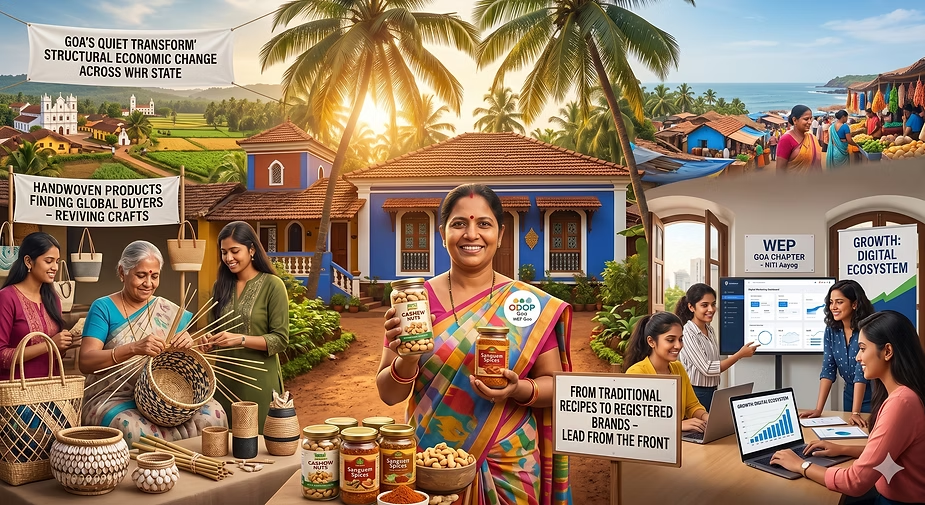
Across Goa, a quiet transformation is unfolding with remarkable force. It is visible in village homes where traditional recipes are becoming registered food brands. It is visible in artisan clusters where handwoven products are finding buyers far beyond the state. It is visible in startup discussions, self-help groups, and local exhibitions where women are no longer participating from the sidelines — they are leading from the front.
For decades, women in Goa have contributed enormously to the economy, often without formal recognition. They managed households, supported agricultural activity, preserved culinary traditions, sustained local markets, and carried forward traditional crafts that defined Goan identity itself. Yet much of this contribution remained informal, invisible, and economically undervalued. Their work powered communities, but opportunities to transform those skills into scalable enterprises remained limited.
Today, that reality is changing rapidly.
A powerful ecosystem of entrepreneurship support, policy intervention, digital access, and financial inclusion is helping women across Goa move beyond participation into leadership. Through initiatives such as the Women Entrepreneurship Platform (WEP) Goa, the One District One Product (ODOP) scheme, startup acceleration programs, artisan support networks, and women-centric welfare systems, the state is witnessing the rise of a new generation of female entrepreneurs.
This transformation is not confined to urban centers alone. It is happening in the villages of Sanguem, the coastal communities of South Goa, the artisan hubs of Ponda, and the growing startup spaces of Panaji and Porvorim. Across the state, women are turning traditional knowledge, creativity, and local skills into structured businesses capable of generating income, employment, and long-term economic independence.
For many years, the problem was never a lack of talent. Goa has always possessed extraordinary cultural and entrepreneurial capital in the hands of its women. The issue was access. Access to finance, access to markets, access to mentorship, and access to systems that could help women transition from small informal work into formal economic leadership.
Many women entrepreneurs struggled to secure loans because they lacked collateral ownership. Others found formal business registration processes intimidating due to limited financial literacy or lack of exposure to digital systems. Even highly skilled artisans and food producers often remained dependent on local fairs or seasonal tourism because they lacked structured marketing support or distribution networks.
As a result, countless businesses remained small despite having enormous potential.
Recognizing this gap, policymakers and institutions began building systems specifically designed to support women-led growth. One of the most significant interventions has been the launch of the Women Entrepreneurship Platform Goa chapter under NITI Aayog.
WEP Goa was envisioned as more than just another government scheme. It was designed as a unified ecosystem that could connect aspiring women entrepreneurs with mentorship, training, investors, industry experts, financial support systems, and market opportunities. The objective was simple but transformative: create an environment where women could confidently start, sustain, and scale businesses.
The platform operates around three key pillars — aspiration, knowledge, and action. Women are encouraged not only to dream about entrepreneurship, but are also given the technical and institutional support needed to convert those aspirations into sustainable enterprises. Through workshops, training programs, networking opportunities, and business facilitation support, women are being equipped with tools that were previously inaccessible to many.
This shift is particularly important in a state like Goa, where local enterprise is deeply connected to culture, tourism, food systems, handicrafts, and hospitality. Women are now leveraging these traditional strengths while simultaneously integrating modern business models and digital tools.
The impact is already becoming visible across sectors.
One of the strongest pillars supporting this transformation is the One District One Product scheme. The initiative focuses on identifying products that represent the unique identity of a region and systematically strengthening their commercial potential through branding, packaging, marketing, and logistical support.
For Goa, this has created major opportunities around products deeply connected to local heritage and women-led production systems. Traditional spices, local sweets, handicrafts, cashew products, indigenous textiles, bamboo products, and agricultural specialties are increasingly being positioned as premium, culturally rooted products with larger market value.
Women who were once selling products only within local village markets are now gaining pathways to national exhibitions, curated retail spaces, hospitality chains, and digital marketplaces. This shift from localized selling to broader market integration is fundamentally altering income potential for rural women entrepreneurs.
Importantly, the support extends beyond simple production. Women are receiving guidance in branding, packaging aesthetics, quality standardization, pricing, customer engagement, and digital selling strategies. These seemingly small interventions create enormous economic differences because they allow products to compete in formal markets rather than informal local economies alone.
Alongside food and agricultural products, Goa’s handicraft economy is also experiencing a revival driven largely by women artisans. Traditional shell craft, bamboo work, crochet, pottery, textile weaving, and other indigenous crafts had struggled for years under the pressure of mass-produced industrial goods flooding markets at cheaper prices.
Many artisans feared that younger generations would abandon these traditions entirely because they no longer appeared economically viable.
However, dedicated artisan support programs are now helping transform traditional crafts into sustainable modern businesses. Women artisans are being trained not only in preserving traditional methods but also in adapting products for contemporary consumer demand. Design interventions, exhibition access, digital marketing training, and institutional support are helping traditional craftsmanship regain commercial relevance.
This revival carries significance far beyond economics.
Traditional crafts are living archives of identity. Every handwoven product, every handcrafted item, and every local design language reflects the memory of a community. By supporting women artisans, Goa is simultaneously protecting cultural heritage while generating livelihoods rooted in authenticity.
At the same time, Goa’s women are entering entirely new sectors beyond traditional enterprise models.
A new generation of women-led startups is emerging across fields such as sustainable tourism, wellness, digital commerce, eco-friendly packaging, nutrition, fashion, technology-enabled services, and creative industries. Programs such as the BRICS Woman Startup Contest are helping expose Goan women entrepreneurs to national and international startup ecosystems, mentorship opportunities, and investment networks.
This represents a major psychological shift.
For many years, entrepreneurship in Goa was often associated with hospitality businesses, small shops, or family-owned operations. Today, women are building scalable brands, digital businesses, and innovation-driven enterprises capable of competing nationally.
Technology has played a major role in accelerating this shift.
Digital platforms have dramatically reduced entry barriers for women entrepreneurs. Through social media, e-commerce tools, and digital payment systems, women can now directly reach consumers without depending entirely on intermediaries or expensive marketing agencies.
A home-based entrepreneur selling local products through Instagram or WhatsApp can now access customers across India. Artisans can showcase the process behind their crafts, building emotional connection and authenticity around their products. Small-scale businesses that once depended entirely on footfall are now participating in the digital economy.
This digital visibility is changing not only business outcomes but also social confidence.
Women who once hesitated to speak publicly are now pitching products, handling customer negotiations, managing online orders, and building independent business identities. Economic participation is evolving into leadership.
The broader impact of this transformation extends well beyond individual income generation.
When women become financially independent, the benefits ripple across entire communities. Studies consistently show that women reinvest larger portions of their earnings into family welfare, healthcare, education, and long-term household stability. This creates intergenerational impact.
Children grow up witnessing entrepreneurship and leadership within their homes. Families gain greater financial resilience. Rural economies become more diversified and locally sustainable. Communities become less dependent on seasonal economic cycles.
This is precisely why women-led development is increasingly being recognized as central to the vision of Viksit Bharat. Inclusive growth cannot occur if half the population remains economically underrepresented.
Goa’s approach demonstrates how women entrepreneurship can simultaneously drive economic development, cultural preservation, social empowerment, and local innovation. From traditional handicrafts to digital startups, women are becoming active architects of the state’s future economy.
Already, approximately 1.5 lakh women across Goa are being supported through various welfare, entrepreneurship, self-help, and financial assistance initiatives. This represents one of the largest grassroots empowerment ecosystems operating within the state.
The significance of this number cannot be overstated.
Behind every supported entrepreneur is a household gaining stability, a child receiving better opportunities, a local economy becoming stronger, and a community witnessing the visible impact of women-led progress.
The narrative of Goa itself is evolving through this transformation.
For years, the state was viewed primarily through the lens of tourism. Today, another story is emerging alongside it — one where women are building businesses, preserving traditions, creating employment, embracing innovation, and shaping the next chapter of Goa’s development.
The change is visible everywhere.
It is visible in the confidence of women presenting products at exhibitions. It is visible in artisan groups collaborating instead of struggling individually. It is visible in startup founders pitching ideas with ambition and clarity. It is visible in local entrepreneurs who no longer see their skills as small or informal, but as scalable and valuable.
This is more than empowerment rhetoric.
It is structural economic change.
Goa’s women are no longer waiting for opportunity to arrive. They are creating opportunity themselves — with their own products, their own businesses, their own ideas, and their own identities.
And as these women rise, the state rises with them.
Because when women lead growth, development becomes deeper, stronger, and more inclusive for everyone.