


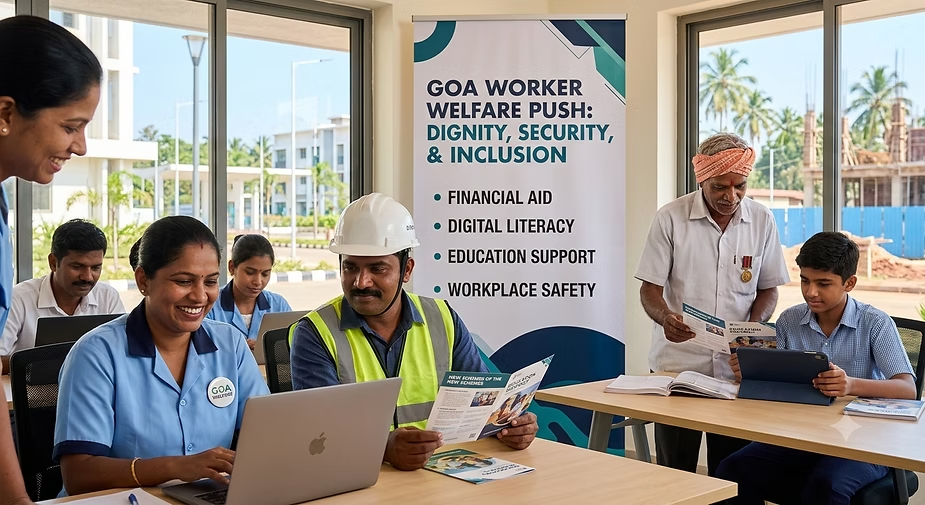
From financial aid and digital literacy to education support and workplace safety, Goa’s latest labour reforms are being seen as a significant step toward people-centric governance
In an era where conversations around economic growth often revolve around infrastructure, investment and industrial expansion, the Goa government is attempting to place workers and their families at the centre of development.
A series of labour welfare initiatives announced by Goa Chief Minister Pramod Sawant on May 1 — coinciding with International Workers’ Day — has drawn praise from both labour unions and industry representatives, an uncommon convergence that many see as a sign of balanced and inclusive governance.
The measures announced by the state government go beyond conventional welfare support. They combine financial security, digital empowerment, educational assistance and social protection into a broader framework aimed at improving the quality of life of workers across sectors.
From compensation for workplace injuries and deaths to digital literacy programmes, medical aid for elderly parents, educational support for children and accident insurance coverage, the initiatives reflect a governance approach focused not merely on employment, but on long-term human development.
More importantly, the response from workers, unions and private industry indicates that these measures are being viewed not as symbolic announcements, but as policies with tangible real-world impact.
Recognising Workers as the “Backbone of Goa’s Economy”
During the May Day function where the schemes were announced, Chief Minister Pramod Sawant described workers as the “backbone of Goa’s economy”, a statement that resonated strongly in a state where tourism, hospitality, construction, manufacturing and service industries depend heavily on skilled and semi-skilled labour.
The announcement package included several direct welfare measures:
- Rs 50,000 compensation for families of deceased workers
- Rs 25,000 assistance for workers injured at the workplace
- Digital literacy training programmes
- Medical aid support for elderly parents of workers
- Coaching support for children preparing for competitive examinations
- Tuition fee reimbursement schemes
- Accident insurance coverage under the Pradhan Mantri Suraksha Bima Yojana (PMSBY)
The government also honoured 20 workers with the Shram Gaurav Shramik Mitra Award, recognising long-term contribution and commitment to the workforce.
Additionally, workers with more than 20 years of service can apply for a one-time incentive of Rs 15,000 through the Labour Welfare Department. Applications can be submitted either directly by workers or through private company managements with proof of long-term service.
According to the state government, more than 1.4 lakh workers have already registered under the programme — an indication of both the scale of Goa’s workforce and the demand for institutional social protection.
A Shift from Welfare to Workforce Empowerment
What makes the Goa government’s initiatives notable is that they move beyond traditional compensation-based welfare and place equal emphasis on empowerment and employability.
One of the most widely discussed aspects of the announcement has been the focus on digital literacy training. In today’s increasingly technology-driven economy, digital skills are rapidly becoming essential not only for white-collar professions but also for service workers, technicians, hospitality staff and small entrepreneurs.
Ashley Lazarus Dias, Chief Administrative Officer of Goa-based Veejay Facility Management Pvt Ltd, welcomed the initiative and described it as a forward-looking investment in the workforce.
“Digital skills are no longer optional; they are essential in today’s technology-driven world,” Dias said while appreciating the government’s decision to provide full fee reimbursement for digital training programmes.
According to industry representatives, this aspect of the scheme could significantly improve worker confidence, adaptability and employability in a changing job market.
The emphasis on skills development also reflects a broader economic reality. As industries adopt automation, digital systems and technology-enabled operations, workers without access to digital education risk being excluded from future opportunities.
By subsidising and promoting digital literacy, the government is attempting to bridge that gap.
Industry stakeholders believe this can have long-term economic benefits not only for workers but also for businesses that increasingly require digitally aware employees.
Dias described the welfare package as “not just an investment in skill policy, but an investment in people and the hardworking workforce.”
That distinction is important.
Governments across India often announce industrial policies aimed at attracting investment. Goa’s latest approach suggests that workforce preparedness and worker welfare are being viewed as equally important pillars of economic development.
The Importance of Family-Centred Welfare
Another striking feature of the welfare package is its focus on the family ecosystem surrounding workers.
Many labour welfare programmes traditionally focus solely on wages or workplace compensation. Goa’s new initiatives recognise that worker productivity and stability are deeply connected to family security, healthcare access and educational opportunities.
The schemes addressing medical aid for elderly parents and educational support for workers’ children have received particularly strong reactions from labour groups.
For many lower and middle-income workers, healthcare expenses remain one of the largest financial vulnerabilities. In emergencies, workers often depend on provident fund withdrawals or loans to manage treatment costs.
Labour union leader Puti Gaonkar noted that the government’s assistance could significantly reduce this burden.
“Many workers currently depend on provident fund loans to meet medical expenses, and the government’s assistance would reduce their burden during health emergencies,” he said.
This observation reflects a larger issue faced by workers across India: economic insecurity despite years of employment.
Unexpected medical emergencies, workplace injuries or educational expenses frequently push families into debt cycles. Policies that reduce these vulnerabilities can create long-term social stability.
The tuition reimbursement and educational support schemes are also being viewed as transformative, especially for children pursuing professional courses such as MBBS, engineering and competitive examinations.
For working-class families, professional education often represents upward mobility across generations. However, the high cost of coaching and tuition can make these aspirations difficult to achieve.
By supporting education, the state government is not only helping workers in the present but also investing in future human capital.
Rare Consensus Between Industry and Labour
One of the most significant aspects of the announcements has been the rare consensus between labour unions and industry representatives.
In labour policy discussions, governments often face criticism either from workers who feel unsupported or from businesses concerned about regulatory burdens.
In this case, both sides have largely welcomed the initiatives.
Industry representatives see the programmes as investments in workforce stability, productivity and long-term skill development.
Labour unions view them as overdue social protections that acknowledge the realities faced by workers and their families.
Puti Gaonkar particularly highlighted the Rs 15,000 work excellence incentive and financial support during serious illnesses as meaningful interventions for workers.
“Through my union, I thank the government and request early implementation of these schemes,” he said.
The emphasis on implementation is crucial.
While announcements generate headlines, their real impact depends on efficient execution, accessibility and transparency. Labour groups are now watching closely to see how quickly benefits reach workers on the ground.
More Than Welfare: Encouraging Economic Self-Reliance
Underlying many of these initiatives is a broader governance philosophy increasingly visible in several Indian states — encouraging citizens not only to seek employment but also to become economically self-reliant.
The emphasis on digital literacy, skill-building and educational support aligns with a larger vision of enabling workers and families to improve their earning capacity over time.
Government officials and industry voices have repeatedly stressed that modern economies require adaptable and skilled workforces capable of participating in new sectors and technologies.
This becomes especially important in a state like Goa, where tourism and services dominate the economy, but where diversification and entrepreneurship are increasingly necessary for sustainable growth.
By creating safety nets while simultaneously encouraging skill development, the government appears to be promoting a dual approach:
- protect workers during vulnerabilities,
- while preparing them for future economic opportunities.
This model reflects a shift from purely subsidy-based governance toward capability-building governance.
Parallel Push for Worker Safety and Labour Reforms
The welfare announcements also come alongside broader labour reforms being drafted by the Goa government.
The state has proposed the Goa Occupational Safety, Health and Working Conditions (Labour) Rules, 2026, aimed at strengthening workplace safety, protecting labour rights and simplifying compliance procedures for businesses.
The draft rules, currently in the public domain for feedback and objections, align with central labour laws and attempt to consolidate multiple labour regulations into a more streamlined framework.
Among the key provisions proposed are:
- Mandatory reporting of fatal workplace accidents within 24 hours
- Reporting obligations to police authorities and victims’ families
- Enhanced safety measures for women employees working before 6 am or after 7 pm
- Mandatory transport facilities for women workers
- CCTV surveillance near critical workplace areas
- Well-lit working conditions
- Compliance requirements under the Sexual Harassment of Women at Workplace Act, 2013
The draft rules also seek to ensure that employers maintain healthy and secure work environments while simplifying certain compliance mechanisms for businesses.
This parallel focus on welfare and workplace regulation suggests that the government is attempting to build a more comprehensive labour ecosystem rather than isolated welfare announcements.
Why the Initiatives Matter Beyond Goa
Goa’s welfare initiatives may appear state-specific, but they also reflect larger national conversations around labour dignity, social protection and inclusive growth.
Across India, informal and semi-formal workers often face:
- inadequate insurance coverage,
- limited social security,
- rising healthcare costs,
- skill gaps,
- and educational barriers for their families.
As India moves toward becoming a larger global economy, the challenge for policymakers is ensuring that growth translates into improved living standards for ordinary workers.
In that context, Goa’s initiatives represent an example of governance focused on direct social impact.
The measures may not be massive headline-grabbing economic reforms, but they address practical concerns that affect everyday lives:
- healthcare,
- workplace safety,
- education,
- digital inclusion,
- and emergency financial support.
For workers living paycheck to paycheck, these interventions can make a substantial difference.
Governance That Becomes Visible in Everyday Life
One of the defining tests of governance is whether ordinary citizens feel its impact in their daily lives.
Roads, airports and investment summits are visible symbols of development, but policies related to worker dignity and family security often shape public trust more deeply over time.
The Goa government’s labour welfare package has generated attention precisely because it touches multiple aspects of workers’ lives beyond employment itself.
It recognises workers not simply as economic units, but as individuals with families, aspirations, vulnerabilities and long-term ambitions.
The inclusion of educational support, digital training and healthcare assistance indicates an understanding that economic development becomes sustainable only when it is socially inclusive.
At a time when governments across India are competing to attract investment and build infrastructure, Goa’s latest initiatives highlight another equally important dimension of governance: investing in people.
If effectively implemented, these schemes could strengthen workforce confidence, improve social security and create a more resilient labour ecosystem in the state.
For thousands of workers and families, the real success of these initiatives will not be measured in announcements or headlines, but in whether they reduce uncertainty, expand opportunity and provide a greater sense of dignity and security.
And that, ultimately, is where governance becomes meaningful.