


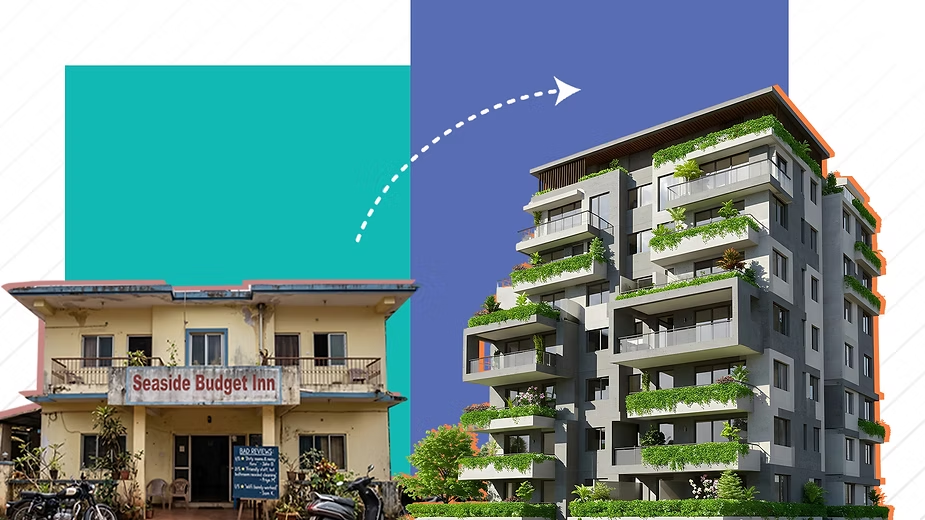
For years, Goa’s tourism success was measured largely by one thing: numbers. More tourists, more hotels, more footfall, and longer peak seasons were often seen as signs of growth. The state became one of Bharat’s most recognisable travel destinations, attracting everyone from backpackers and party tourists to luxury travellers and international visitors.
But over time, a difficult question began emerging alongside that growth: how much tourism is too much tourism?
As crowds increased across beaches, roads, markets, and popular destinations, concerns around infrastructure pressure, environmental degradation, waste management, traffic congestion, and declining visitor experience became impossible to ignore. Many Goans also began questioning whether rapid tourism expansion was truly improving long-term quality of life for local communities or simply increasing pressure on the state’s limited resources.
Now, Goa appears to be entering a new phase in its tourism journey — one focused less on chasing higher tourist numbers and more on building a smarter, more sustainable, and higher-value tourism economy.
The Tourism Department is increasingly signalling a strategic shift towards “Quality over Quantity,” with discussions around freezing registrations for new budget hotels in the C & D categories while simultaneously preparing to launch a dedicated MICE Bureau aimed at attracting destination weddings, global events, exhibitions, conferences, and premium tourism activity.
Taken together, these developments suggest something much larger than a routine tourism policy adjustment. They indicate a possible repositioning of Goa itself — from a mass tourism destination towards a more curated, experience-driven, and sustainability-focused model of growth.
For decades, Goa has remained one of Bharat’s strongest tourism economies. Hospitality, transport, entertainment, restaurants, nightlife, local retail, tourism services, and event businesses all grew around the state’s popularity as a travel destination. Tourism created employment opportunities for thousands of people while contributing significantly to economic activity across both urban and coastal regions.
However, the rapid expansion of accommodation infrastructure, especially within lower-budget segments, also intensified competition and created long-term sustainability concerns. As more low-cost inventory entered the market, pricing pressure increased, operational profitability weakened for many businesses, and pressure on local infrastructure became more visible.
In several parts of Goa, overcrowding during peak seasons became a recurring challenge. Roads experienced heavy congestion, waste management systems faced strain, and concerns about environmental degradation became more frequent. Beaches, villages, rivers, and local ecosystems increasingly faced the impact of uncontrolled tourism expansion.
This changing reality appears to be one of the key reasons behind the proposed strategic shift.
The possible freeze on new C & D category hotel registrations reflects an effort to slow down volume-based expansion while encouraging a more balanced tourism ecosystem. Rather than continuously increasing accommodation numbers, the focus now appears to be shifting towards improving tourism quality and economic value generation.
Importantly, this does not mean Goa is moving away from tourism. Instead, it suggests the state may be trying to attract tourism that creates stronger economic impact with lower long-term pressure on infrastructure and resources.
That distinction is critical.
A high-volume tourism model often prioritises maximum arrivals, sometimes without adequately considering carrying capacity, infrastructure limitations, environmental sustainability, or local quality of life. A high-value tourism model, on the other hand, focuses on generating stronger economic outcomes through better experiences, premium services, curated tourism, organised events, and visitors who spend more during their stay.
For Goa, this could potentially create a more sustainable tourism economy over time.
One of the biggest arguments in favour of the new approach is that higher-value tourism can strengthen local businesses more effectively than endless volume expansion. Instead of saturating the market with low-cost competition, the emphasis is gradually shifting towards quality hospitality, premium experiences, and tourism segments that generate stronger local spending.
This transition could benefit boutique hotels, restaurants, local artisans, transport operators, event professionals, tourism service providers, wellness businesses, and hospitality workers by increasing the overall economic value generated per visitor.
That is where the proposed MICE Bureau becomes especially significant.
MICE — Meetings, Incentives, Conferences, and Exhibitions — is one of the fastest-growing segments in global tourism. Cities and destinations across the world actively compete to attract conferences, corporate summits, exhibitions, destination weddings, and large-scale premium events because of their massive economic multiplier effect.
Goa already possesses many natural advantages for becoming a major MICE destination. Its coastal setting, hospitality infrastructure, airport connectivity, luxury resorts, and international tourism identity make it attractive for destination events and corporate tourism.
The proposed MICE Bureau is expected to provide single-window clearances for destination weddings, business summits, concerts, exhibitions, and other large-scale events. This could significantly improve operational ease for organisers while positioning Goa more competitively within the premium events economy.
The economic implications of this could be substantial.
High-value events typically generate spending across multiple sectors simultaneously. Hotels, decorators, caterers, transport providers, event managers, photographers, entertainers, local vendors, and tourism operators all benefit from organised event tourism. Visitors attending conferences or weddings also tend to spend more per trip and often extend stays for leisure travel.
By focusing more strongly on these segments, Goa may be attempting to increase tourism revenue without proportionally increasing overcrowding and infrastructure pressure.
Another major factor driving the strategic shift is sustainability.
Goa’s tourism appeal is deeply connected to its environment, culture, and lifestyle. Beaches, rivers, forests, villages, architecture, cuisine, music, and local traditions form the foundation of the state’s identity. However, unmanaged tourism growth can gradually damage the very ecosystem that attracts visitors in the first place.
Environmental degradation, excessive construction, traffic congestion, overcrowding, and declining civic quality can weaken both resident quality of life and tourist experience over time. Across the world, travellers are increasingly prioritising cleaner, more organised, culturally authentic, and environmentally responsible destinations.
This makes sustainability not just an environmental issue, but also an economic one.
The “quality over quantity” approach therefore reflects a broader understanding that long-term tourism success depends on preserving Goa’s uniqueness rather than maximising tourist numbers indefinitely.
Global tourism trends also appear to support this transition.
In recent years, tourism worldwide has increasingly moved towards experiential travel, wellness tourism, eco-tourism, luxury stays, remote work destinations, curated hospitality, and event-driven travel experiences. Travellers today often seek authenticity, comfort, exclusivity, and cultural connection rather than only low-cost accommodation.
Goa’s evolving tourism strategy aligns closely with these global patterns.
The state already has strong positioning in wellness tourism, boutique hospitality, music festivals, destination weddings, culinary tourism, and creative communities. Strengthening these segments could help diversify tourism revenue while building a more resilient long-term tourism economy.
At the same time, the strategy shift could encourage better standards across the tourism industry itself.
Excessive low-cost competition can sometimes discourage investment in quality improvements because businesses operate under constant pricing pressure. A more balanced tourism ecosystem may allow operators to focus more on service quality, infrastructure upgrades, hospitality standards, and visitor experience.
For local communities, the long-term impact could extend beyond tourism revenue alone.
Higher-value tourism has the potential to create stronger employment opportunities across hospitality, event management, wellness, entertainment, transport, creative industries, and tourism services. Skilled jobs and premium tourism services often generate higher earnings compared to purely volume-driven tourism markets.
However, the transition will also require careful management.
Any major tourism policy shift affects multiple stakeholders differently. Smaller operators dependent on budget tourism may worry about reduced opportunities, while others may welcome a move towards stronger profitability and more sustainable growth patterns.
Balancing economic inclusivity with sustainability goals will therefore remain one of the biggest challenges for policymakers.
Ultimately, the success of Goa’s tourism transition will depend not only on policy announcements but also on implementation. Infrastructure planning, waste management, environmental enforcement, transport systems, event regulation, and community participation will all play critical roles in determining whether the strategy delivers long-term benefits.
What remains clear, however, is that Goa’s tourism conversation is changing.
The focus is no longer only about attracting more people every year.
Increasingly, the discussion is about what kind of tourism Goa wants to build for the future — tourism that strengthens the economy without overwhelming infrastructure, tourism that creates opportunity without damaging ecology, and tourism that supports local communities while preserving Goa’s cultural identity.
The proposed freeze on certain budget hotel registrations and the launch of the MICE Bureau signal that the state is now leaning more decisively towards a future centred on sustainable growth, premium experiences, and higher-value tourism.
For Goa, this is more than a policy adjustment.
It is an attempt to redefine the direction of the state’s tourism economy itself.
And if implemented successfully, it could reshape how Goa grows over the next decade — not through bigger crowds alone, but through smarter, more sustainable tourism built for the future.