

The conversation around Persons with Disabilities (Divyangjan) has largely revolved around welfare, charity, and basic financial assistance. While such support systems remain important, modern society demands a far more empowering and inclusive approach. Goa is now taking a significant step in that direction by reshaping the future of disability empowerment through skill development, employability, and self-reliance.
The Directorate of Social Welfare has introduced a transformative initiative under the Divyang Kaushal Yojana, aimed at creating meaningful opportunities for Persons with Disabilities across the state. This initiative is not merely about providing assistance—it is about unlocking potential, encouraging independence, and ensuring that Divyangjan becomes an active contributor to Goa’s growing economy. Through 100% free vocational and skill-based training, the state is sending a powerful message that every citizen deserves the opportunity to build a dignified and prosperous future.
At the core of this initiative lies a major shift in policy thinking. Instead of limiting support to monthly welfare benefits, the government is investing directly in human capital by creating pathways to employment and entrepreneurship. Eligible Persons with Disabilities are now being offered completely free vocational training, removing the financial barriers that often prevent individuals from accessing quality education and professional development opportunities.
For many families, the costs associated with disability care, adaptive technologies, transportation, and specialized training can be overwhelming. This scheme helps ease that burden by offering structured and fully funded training opportunities designed specifically around the needs of Divyangjan. The government is also partnering with registered organizations, NGOs, and institutions to establish “Sheltered Workshops” that provide safe, accessible, and supervised learning environments.
To support these centres effectively, the state is providing substantial financial assistance, including grants of up to ₹10 lakh for setup and ₹2.90 lakh per month for operational expenses. These workshops are designed to ensure that training is personalized according to the physical, sensory, and cognitive requirements of every participant. This creates an inclusive environment where individuals can learn, grow, and develop confidence without facing accessibility barriers.
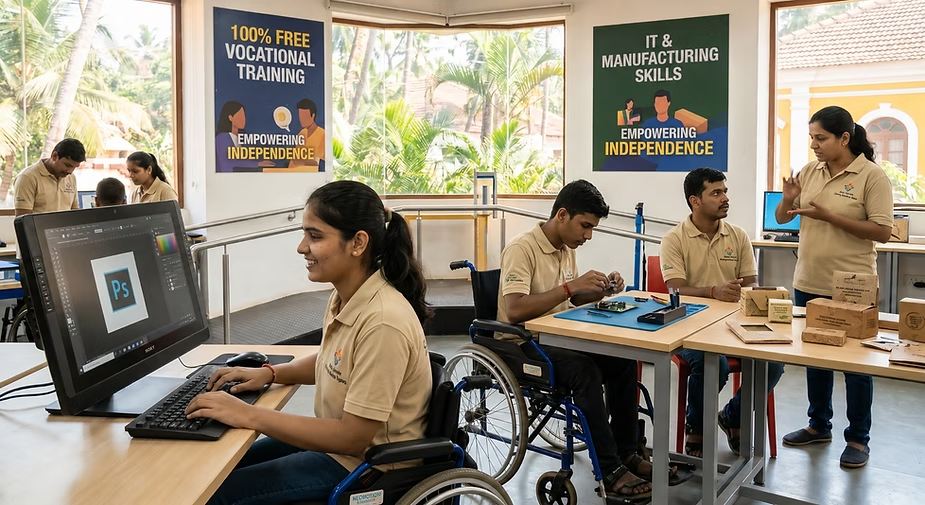
One of the most forward-looking aspects of the scheme is its focus on future-ready skills. Rather than limiting vocational opportunities to traditional low-income activities, the initiative is aligned with modern market demands and emerging industries. A major emphasis has been placed on Information Technology (IT) and digital skills, recognizing the growing importance of the digital economy and remote work opportunities.
Participants can receive training in computer operations, data entry, digital marketing, software accessibility testing, and other technology-driven fields. The rise of remote work and digital services has created new possibilities where physical limitations no longer define professional capability. By introducing adaptive technologies such as screen readers, accessible software, and specialized learning support, the program ensures that individuals with visual, hearing, or mobility impairments can fully participate in the digital workforce.
These skills are highly relevant in today’s economy, where businesses are increasingly adopting inclusive hiring practices and seeking diverse talent pools. Through this initiative, Goa’s Divyangjan are being equipped not only with technical knowledge but also with the confidence to compete in modern professional environments.
Alongside digital training, the scheme also places strong emphasis on localized manufacturing and practical vocational work linked directly to Goa’s regional economy. Goa’s economy thrives on tourism, small-scale industries, local products, handicrafts, and sustainable enterprises. The vocational training program integrates these economic realities by offering practical training in areas such as eco-friendly packaging, food processing, handicrafts, and electronic assembly work.
Participants are provided with adaptive tools, ergonomic workstations, and accessible machinery that allow them to safely engage in manufacturing and production activities. This practical exposure helps individuals understand the value of their work while also creating opportunities for sustainable livelihoods within local industries.
Importantly, the initiative recognizes that every individual has different strengths, interests, and abilities. By offering both digital and manufacturing-focused pathways, the scheme ensures that no one is excluded and that participants can pursue careers suited to their unique talents and aspirations.
Beyond employment, the larger vision of the initiative is rooted in independence and dignity. Financial independence has a transformative impact on an individual’s life. For Persons with Disabilities, earning an income is not only about economic stability—it is also about confidence, self-worth, and social inclusion.
The ability to make personal decisions, contribute to family income, and participate actively in society fundamentally changes how individuals view themselves and how society views them. This initiative directly challenges outdated stereotypes that often portray Persons with Disabilities as dependent or incapable. Instead, it recognizes them as skilled individuals with valuable contributions to make in the workforce and the broader community.
The scheme also encourages entrepreneurship and self-employment. Not every participant may choose a traditional job, and many may aspire to build their own businesses. The skills provided through the sheltered workshops can help individuals launch small enterprises, digital service businesses, or cooperative manufacturing ventures catering to local markets and tourism-related industries.
This entrepreneurial focus is particularly important because true empowerment comes from creating opportunities for long-term independence. By supporting self-employment and innovation, the initiative enables Divyangjan to become job creators as well as job seekers.
The impact of this initiative extends beyond individual beneficiaries. When a Person with Disability gains employment and financial independence, the entire family experiences greater stability and security. Caregivers and parents who may have sacrificed their own professional opportunities to provide full-time support often gain the freedom to rebuild their own careers and aspirations.
At the same time, increased participation of Divyangjan in the workforce will gradually reshape workplace culture across Goa. Businesses and organizations will be encouraged to improve physical accessibility, adopt inclusive practices, and recognize the value of diverse teams. Studies across the world have consistently shown that inclusive workplaces are often more innovative, resilient, and productive.
The government’s focus on placement assistance further strengthens the initiative by helping bridge the gap between training and employment. This ensures that participants receive support not only during the learning process but also while transitioning into professional careers.
In many ways, Goa is setting an important example for inclusive development in Bharat. The 100% free vocational training scheme demonstrates how compassionate governance, when combined with practical and market-oriented policymaking, can create meaningful social transformation.
However, the long-term success of this initiative depends not only on government efforts but also on community participation. Families, educators, local businesses, and civil society organizations all have a critical role to play in spreading awareness, encouraging participation, and supporting inclusive employment practices.
Goa’s future must be one where every citizen, regardless of physical or cognitive challenges, has the opportunity to live with dignity, independence, and purpose. Through this initiative, the state is moving beyond the traditional model of assistance and embracing a future built on empowerment, opportunity, and equal participation.
Goa Speaks for every citizen, and today it speaks for a more inclusive tomorrow—one where barriers are broken, talents are recognized, and every individual is empowered to build a brighter and more independent future.