


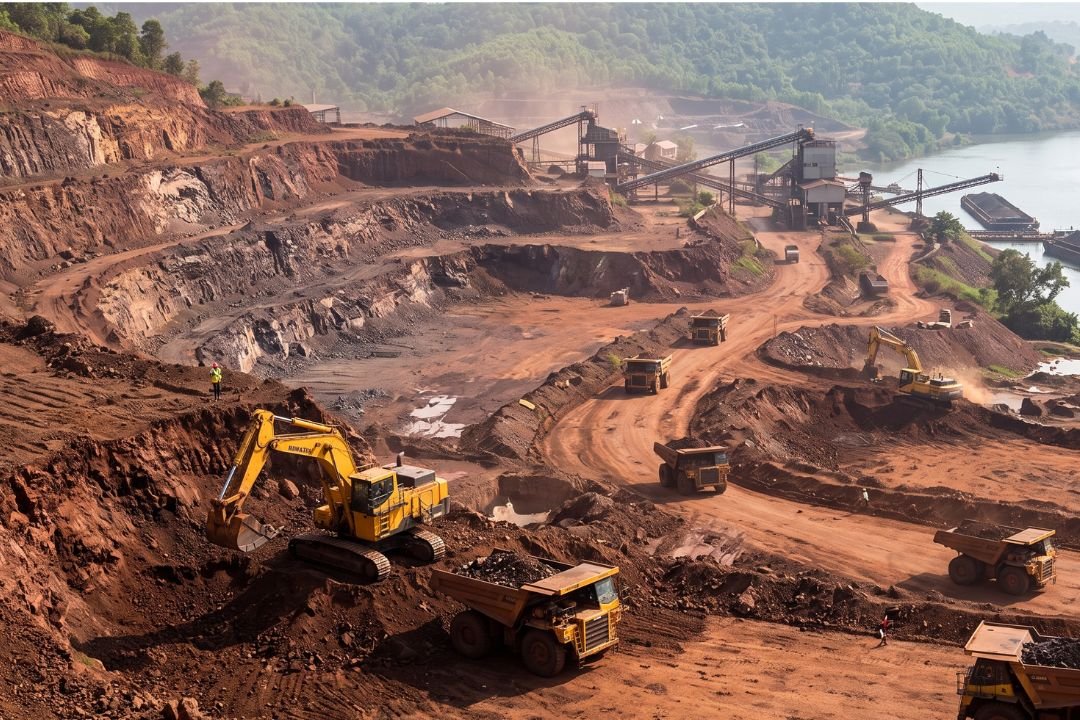
Goa’s mining sector is entering a new phase as the state moves towards regulated resumption of mining activity. Chief Minister Dr Pramod Sawant has said the government remains committed to restarting legal mining operations under the applicable guidelines and regulatory framework, with mining operations and related truck transportation expected to restart by November. The CM said the revival of mining, along with tourism, would support economic activity and provide relief to workers, truck owners and families dependent on the sector.
The latest Goa Economic Survey 2025–26 shows why the sector matters to the state economy. Mining and quarrying has increased its contribution within Goa’s GSDP, while the government continues to expand auctions, mining blocks and regulatory reforms.
Mining’s GSDP Contribution Is Rising
The Goa Economic Survey 2025–26 provides the clearest picture of mining’s recent economic return.
At current prices, Mining and Quarrying accounted for 0.11% of Goa’s GSDP in 2021–22. Its share increased to 0.51% in 2023–24 (Provisional).
The change becomes even more significant when viewed alongside the growth of the Primary Sector. Its share of GSDP at current prices stood at 6.40% in 2021–22 and remained at 6.29% in 2023–24 (P). However, the sector’s growth rate improved sharply after mining activity restarted.
The Primary Sector recorded -12.30% growth in 2021–22, but grew by 14.53% in 2022–23, followed by 0.63% in 2023–24 (P). The Economic Survey states that the 2023–24 growth was mainly due to the restart of mining activities. For 2024–25 (Q), Primary Sector growth is estimated at 15.40%.
This makes mining an important part of Goa’s current economic recovery, even though its direct share of total GSDP remains smaller than tourism, manufacturing and other major sectors.
Read Also: ₹13 Crore Seafarers’ Welfare Centre Set To Boost Mormugao Port
What Goa Faced When Mining Stopped
The impact of mining closures went beyond mines and mining companies.
When mining activity stopped, workers, truck operators, machinery owners, contractors and other businesses connected to the sector lost a major source of economic activity.
The disruption also affected the movement of minerals through Goa’s wider logistics network. Businesses that had invested in trucks, heavy machinery and related services faced a prolonged period of reduced activity.
For mining-dependent communities, the issue was therefore not simply the closure of mines. It affected an entire economic ecosystem built around extraction, transportation, handling and supporting services.
Mining Supports a Wider Business Network
Mining creates activity across several layers of the local economy.
Truck owners depend on mineral transportation. Machinery operators and contractors provide excavation, loading and handling services. Workshops maintain heavy equipment, while fuel stations, tyre dealers, spare-parts suppliers and repair businesses can benefit from increased commercial vehicle movement.
The chain also includes logistics operators, barges, port-related services and other businesses involved in moving minerals from mining areas to markets.
This is why the expected return of work for trucks in areas such as Dharbandora matters beyond the individual vehicle owner. Increased mining activity can bring demand back into several connected businesses.
Read Also: Goa’s Blue Revolution: ₹3,100 Crore ‘Namo Tarang’ Water Metro Cleared to Reshape Coastal Transit
Mining Also Strengthens Government Revenue
Mining contributes to the economy not only through production but also through government revenue.
The state collects revenue connected to mining activities, including royalties and other mineral-related payments. As mining blocks become operational, these activities can generate additional economic and fiscal activity for Goa.
The government has therefore focused on auctions and transparent allocation of mineral resources rather than returning to the earlier lease-based system.
How Government Is Rebuilding Mining Through Auctions, Reforms and Investment
Goa has taken several major steps and achieved notable milestones in restarting mining under a regulated framework:
- Auction of Iron Ore Blocks: The Government of Goa has successfully auctioned 12 Iron ore blocks across the 1st, 2nd, and 3rd NIT. Blocks I through VI (Bicholim, Sirigao–Mayem, Monte De Sirigao, Kalay, Advalpale-Thivim, and Cudnem-Cormolem Mineral Blocks) have become operational, while six additional blocks are currently obtaining Environmental Clearance (EC) and other required permissions. The state has earned ₹252.83 crore in upfront payments across all 12 blocks. Additionally, the department has issued a Notice Inviting Tender (4th NIT) for auctioning 6 more Iron Ore Mineral Blocks.
- Dump Policy and Handling: Following the Hon’ble Supreme Court order dated 13/12/2022, the government notified a dump policy on 13/09/2023 for handling and auctioning dumps across two categories (allotment to erstwhile leaseholders or state e-auction based on property, conversion fees, and mining plan criteria). Under these guidelines, five in-principle approval letters were issued to three erstwhile leaseholders, with one final approval granted to handle a dump. The department also floated an NIT for e-auctioning 10 dumps on the MSTC Portal on 05/11/2025 (scheduled for end of February 2026). Furthermore, following the Supreme Court order dated 09/08/2024, an additional 1.94 million tons of identified iron ore underwent the 30th and 31st e-auctions on the MSTC portal.
- Central Support and State Rankings: The Centre approved ₹500 crore under the Scheme for Special Assistance to States for Capital Investment (SASCI) 2025–26, allocating ₹400 crore for activating two e-auctioned blocks and ₹100 crore linked to Sustainable Mining Resource Index (SMRI) rankings. Goa also secured the 1st Rank among Category B States in the State Mining Readiness Index published by the Ministry of Mines.
Minor Minerals and Digital Reforms: During FY 2025–26, two leases for basalt and four leases for laterite stone were granted. The department has also streamlined online royalty collection for government projects and developed modules for online transit passes for minor minerals.
Read Also: Goa Shipyard Records ₹4,004 Crore Revenue, Marks Strongest-Ever Financial Performance