


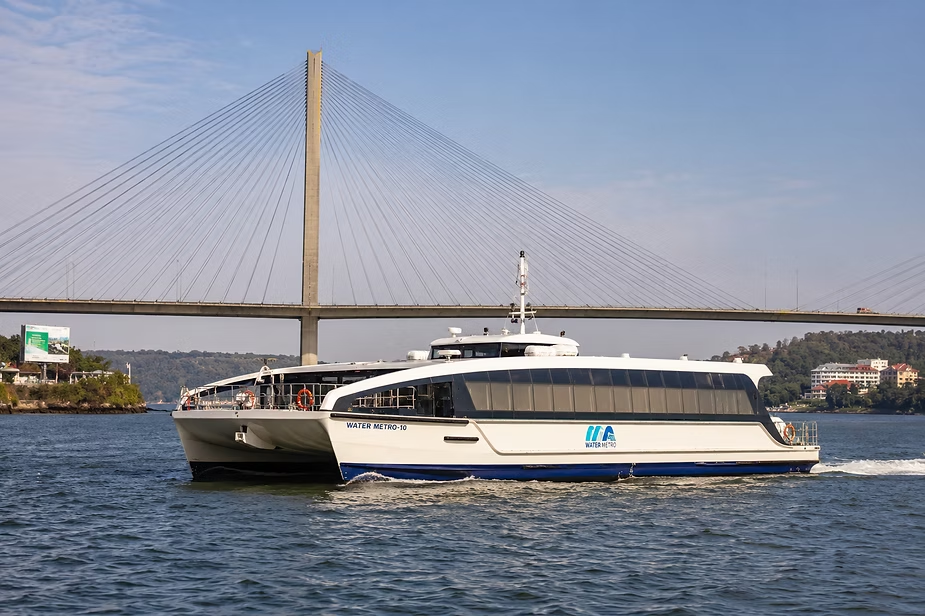
The proposed Goa Water Metro Project aims to transform Goa’s transport infrastructure through a 111-kilometre network of modern electric ferries connecting towns, islands and tourism hubs. If implemented, it could reshape urban mobility in Goa while offering a cleaner solution to the state’s growing traffic challenges.
At a Glance
- Proposed 111-kilometre Goa Water Metro network
- 32 terminals across 8 proposed routes
- Around 87 electric passenger vessels proposed
- Estimated 43,240 daily passengers in the initial years
- Ridership projected to cross 60,600 passengers a day by 2041
- Detailed Project Report (DPR) being prepared by Kochi Metro Rail Limited
- Supported under the Union Government’s expanding inland waterways initiative
Goa’s Rivers Once Built the State. Can They Now Solve Its Biggest Mobility Challenge?
Every Goan knows the feeling.
You leave home on time, only to spend the next thirty minutes inching across the Atal Setu. By the time you enter Panaji, another queue has already formed. During the tourist season, journeys that once took twenty minutes can stretch beyond an hour.
For decades, Goa’s answer to growing traffic has been familiar. Build wider roads. Construct new bridges. Improve junctions. Expand highways.
Those investments have certainly improved connectivity across the state.
Yet traffic continues to grow.
More residents own personal vehicles than ever before. Tourist arrivals continue to rise. Commercial activity is expanding beyond traditional urban centres. Every year, more vehicles compete for the same road space.
Ironically, while roads have become increasingly crowded, another transport network has remained largely untouched.
Goa’s rivers.
The Mandovi, Zuari, Chapora, Sal and Tiracol rivers once served as the state’s original highways. Before bridges connected both banks, boats carried traders, farmers, fishermen, students and families across waterways that formed the backbone of everyday life.
Over time, those waterways gradually became scenic landscapes rather than transport corridors.
Today, the Goa Water Metro Project proposes to bring them back into public life, not as a nostalgic reminder of the past, but as the foundation of a modern transport system powered by electric vessels, smart terminals and scheduled commuter services.
If successful, it would not simply introduce another public transport option.
It could fundamentally change how people move through Goa.
The Goa Water Metro Project Has Moved From Vision to Detailed Planning
After months of preliminary studies, the proposed Goa Water Metro Project has entered an important planning phase.
The Union Ministry of Ports, Shipping and Waterways has asked the Goa Government to fast-track preparation of a Detailed Project Report, commonly known as a DPR. The report is being prepared by Kochi Metro Rail Limited, the organisation responsible for developing India’s first Water Metro system in Kochi.
This marks a significant milestone.
A feasibility study establishes whether an idea is worth pursuing.
A DPR determines how it can actually be built.
It identifies the routes, terminals, engineering requirements, environmental safeguards, project cost, financing model and implementation roadmap.
The feasibility study for Goa examined nearly 28 locations across the state before recommending a network stretching approximately 111 kilometres, supported by 32 passenger terminals and eight operational routes.
The proposal also estimates that nearly 87 electric passenger vessels would eventually operate across the network, creating one of India’s largest urban water transport systems.
Among the proposed corridors are:
- Panaji to Narve
- Betim to Old Goa
- Old Goa to Cumbarjua
- Vasco to Cortalim
- Cortalim to Durbhat
- Old Goa to Sarmanas
- Panaji to Dona Paula to Vasco
- Panaji to Chapora
Government officials are also evaluating a future coastal connection linking Chapora, Keri and Tiracol as part of later expansion phases.
Unlike Goa’s existing ferry services, which primarily function as point-to-point crossings, the Water Metro would operate like any modern urban transport network.
Passengers would board scheduled electric ferries from dedicated terminals, purchase digital tickets, receive predictable departure times and connect seamlessly across multiple destinations.
The objective is not to replace ferries.
It is to create an entirely new layer of public transport using waterways that already exist.
Goa Doesn’t Just Need More Roads. It Needs More Choices.
Every growing city eventually reaches a point where building another road becomes increasingly expensive, environmentally difficult and only temporarily effective.
Goa is approaching that point.
Vehicle ownership in the state has grown steadily over the past decade, while tourism continues to place seasonal pressure on urban roads connecting Panaji, North Goa’s beach belt, South Goa’s commercial centres and Mormugao.
Adding another bridge or widening another highway may solve congestion in one location, but it often shifts bottlenecks somewhere else.
The Goa Water Metro Project offers a fundamentally different approach.
Instead of asking how more vehicles can fit onto roads, it asks how many journeys can move away from roads altogether.
According to the feasibility study, the proposed network could carry approximately 43,240 passengers every day during its initial years of operation.
By 2041, daily ridership is projected to exceed 60,600 commuters, reflecting both population growth and wider adoption of water-based public transport.
For Goa, these numbers represent more than passenger statistics.
They represent thousands of potential car and two-wheeler trips that may no longer compete for limited road space.
If even a fraction of daily commuters choose the Water Metro, the benefits could extend far beyond those travelling on the river.
Less congestion.
More predictable travel times.
Lower fuel consumption.
Reduced emissions.
And a transport network that uses an asset Goa has possessed for centuries instead of continuously expanding its road footprint.
That is why transport planners increasingly describe the project not merely as a ferry service, but as a new chapter in urban mobility in Goa.
It reflects a broader shift in thinking, where Goa transport infrastructure is no longer defined only by roads, bridges and highways, but also by the intelligent use of waterways.
The bigger question is no longer whether Goa has enough rivers.
It is whether those rivers can finally become part of the state’s answer to its growing traffic problem.
A Metro on Water, Not Just Another Ferry
One of the biggest misconceptions surrounding the Goa Water Metro Project is that it is simply an upgraded ferry service.
It isn’t.
Traditional ferries are designed to move people and vehicles across a river between two fixed points. Their role is functional, offering a crossing where bridges do not exist.
A Water Metro is designed differently.
It functions as an integrated public transport network, operating much like a metro rail or city bus system, except that its corridors are rivers instead of roads.
Passengers would board modern electric vessels from purpose-built terminals located along Goa’s waterways. These terminals are expected to feature digital ticketing systems, passenger waiting areas, accessible boarding infrastructure and real-time service information.
Instead of waiting for a ferry to fill up before departing, services would operate on fixed schedules, allowing commuters to plan their journeys with greater certainty.
The proposed vessels themselves represent a significant leap from conventional ferry boats.
Designed for urban commuting, they are expected to include air-conditioned passenger cabins, comfortable seating, CCTV surveillance, GPS-enabled navigation, digital ticketing, life-saving equipment and barrier-free access for senior citizens and persons with disabilities.
Another important feature is integration.
The Water Metro is not intended to operate in isolation. Planners envision it connecting with existing road transport, buses, railway stations and key urban centres, enabling passengers to complete their journeys without relying entirely on private vehicles.
For Goa, this could mark the beginning of a genuinely multimodal transport system, where roads, waterways and public transport work together rather than functioning independently.
The Vision Is Clear. Now Comes the Hard Part.
The Goa Water Metro Project has moved beyond being just an idea. With the Detailed Project Report under preparation, the next few months will determine whether the proposal can progress from planning to execution.
The DPR will establish the project’s financial viability, engineering requirements, environmental safeguards, terminal locations and implementation roadmap. It will also provide answers to the questions that matter most to citizens: How much will it cost? How long will it take? How affordable will the service be? And how well will it integrate with Goa’s existing transport network?
If the project secures the necessary approvals and funding, Goa could join a growing list of Indian cities embracing waterways as a modern mode of public transport. The state’s unique geography offers an advantage that few others possess. Its rivers already connect communities, tourism hubs and economic centres. The challenge lies in transforming that natural advantage into an efficient public transport system.
Success, however, will not be measured by the number of terminals built or vessels launched.
It will be measured by whether a student chooses the Water Metro to reach college. Whether an office-goer reaches Panaji without sitting in traffic. Whether a tourist prefers a river journey over a crowded highway. And whether more people begin to see Goa’s waterways not just as scenic backdrops, but as an everyday part of life.
Infrastructure projects often change skylines. The best ones change habits.
The Goa Water Metro Project has the potential to do both.
It is more than a transport proposal. It is a reimagining of how Goa can grow without relying solely on more roads and more vehicles. It represents a shift towards smarter mobility, cleaner transport and better use of the natural resources the state has always possessed.
Whether that vision becomes reality will depend on careful planning, timely execution and public confidence.
But one question now stands before Goa.